Are titles and descriptions still important?

Geir Halvorsen
Senior SEO-specialist

It's a question I actually received just a few days ago — and yes, it really is still just as important. The title and meta description, together with good copy, are among the most important things to optimize in order to improve your page's position in Google's search results.
If you don't create your own title and meta description, Google will pick text from the page on your website that is most relevant to the search. The result is often not optimal and may not represent your page well. That's why I'm going to walk through how you should go about creating a good title and description that helps you rank well and attract clicks in the search results.
Title and meta description for e-commerce
When working with titles and descriptions in e-commerce, it's difficult to find time to optimize all product pages since we're often talking about thousands of pages. In these cases, it's good to have some automation that generates titles for your product pages. Some elements that are important to include are brand and product name (followed by your company name at the end) — for example "Nike – Air Force 1 LV8 | Löplabbet".
I usually recommend starting by manually optimizing the homepage, all category pages, and then reviewing products that are especially important or products that you see are starting to rank well. These are the pages you want to give a little extra push.
Examples of two less effective titles and descriptions
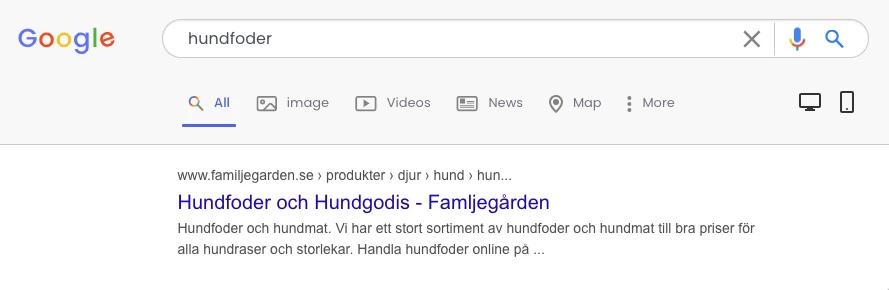
This truncated sentence ruins the overall impression and the CTA is cut off. A title and description with too few characters will instead look sloppy and won't engage the user. It will disappear compared to a title and description with more text and a clear CTA.
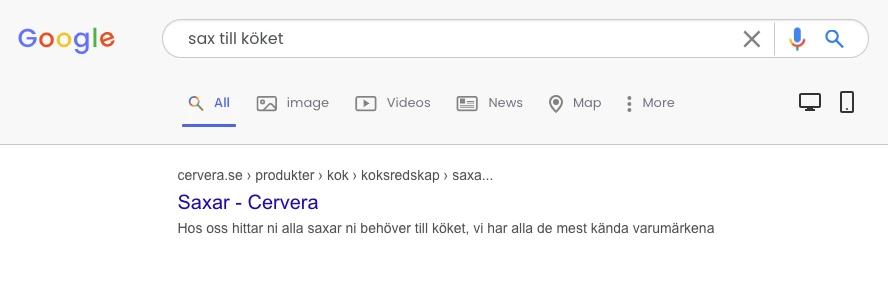
This title and description has too few characters. The headline includes the keyword "scissors" but it's not a headline that engages or encourages clicks. Additionally, the description is too short and lacks a CTA.
What should a good title and meta description contain?
For a title and description to be appealing and relevant, it should contain these elements:
- A brief description of the content on the page it links to.
- Selected keywords — their placement doesn't matter much, but make sure to include the most important keyword in the title.
- Call to action — can be a prompt such as "contact us", "read more", or "get a free quote".
- Company name.
Through a good title and description, someone searching on Google can see whether your page contains what they're looking for. At the same time, you can present your company and offering to encourage purchases, contact, or further reading. A classic win-win, in other words.
Example of a good title and description for a product page
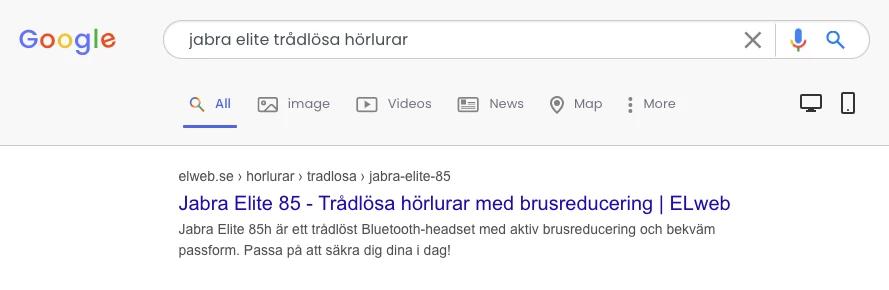
This title and description contains everything a Google user wants: a descriptive headline, a good presentation of the page's content, and a clear sender with a CTA in the description.
How many characters?
A title and description have limited space. Google measures space in pixels, but since this can be difficult to check yourself, many people work with a limited number of characters.
Stay within these limits:
- Title: max 65 characters.
- Description: max 160 characters.
Remember that spaces also count toward the maximum character count. If a title and description has too many characters, the full text won't be displayed, which can confuse the reader and result in a missed click.
There are free tools online that help you count both pixels and characters, and show you what the result will look like.
Summary
Make sure the following are included in your title and meta description
- The company name.
- Description of the page's content.
- Selected keywords in both the headline and description.
- CTA — call to action.
- Appropriate length (max 65 characters in the title and 160 in the description).
- Engaging and relevant text.
Good luck with your e-commerce and your success on Google!
#motilloseofredag