How do SEO and CRO work together?

Geir Halvorsen
Senior SEO-specialist
SEO stands for Search Engine Optimization and is about optimizing your site for search engines – getting the right "traffic". CRO stands for Conversion Rate Optimization and is about converting the traffic you receive into purchases. You might think that SEO and CRO are about two different things, but that's not entirely true. In this article, I explain why that's not the case.
SEO helps you rank well in search results on search engines, such as Google, so that you get more relevant traffic to your site. A site that doesn't rank won't get any conversions or revenue either, but if your goal is only about ranking, you're working with SEO the wrong way. Every part of your site should help searchers find answers to their questions and bring them one step closer to becoming your customers.
So how can you create content that not only ranks well, but actually also converts your visitors into customers?
Create content that matches search intent
Without text content on your site it won't rank, but before you start producing content it's important to find out the search intent. In a previous article I wrote about keyword analyses I explain what search intents are and why this is important for the content on your site. Whether you're writing a blog post or a product description, relevant content is the most important factor for ranking on search terms that bring you new customers.
Google uses several factors to determine which page should rank for different search terms. Google only wants to show results that answer a searcher's question and give its users the best user experience (UX), so if you want to rank well in search results and convert visitors into customers, you need to match the search intent.
In other words, it's important to create content that answers your customers' questions and delivers the information they need. Let's look at two examples.
Example 1 – a transactional search
Let's say we are a company that sells car parts and accessories. A common search might then be "engine oil Volvo V70 2005". This is how Google responds to that:
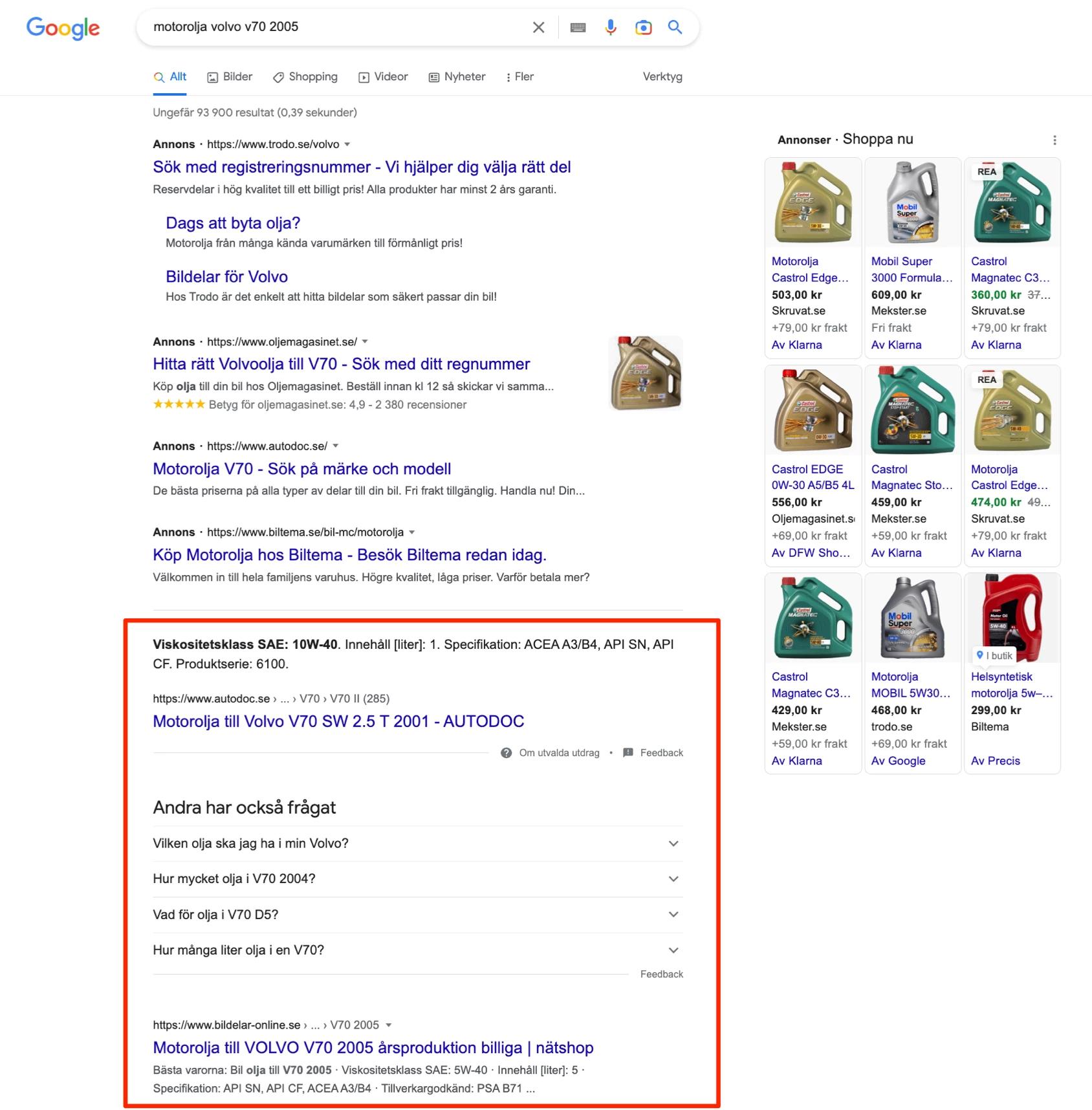
The search made here is a transactional search. The intent is to buy engine oil for a Volvo V70, but the searcher may not entirely know which type of oil is best or what viscosity is needed, and doesn't specify exactly which model the car is. The first two search results are quite informative. The first result from Autodoc.se suggests which type of oil may be needed for one of the more common V70 models from this era. Bildelar-online.se also mentions that they are cheap.
Since the search is quite open, you also get suggestions for other relevant searches made in connection with this one. It's quite likely that Autodoc or Bildelar-online will get my order here.
Example 2 – an informational search
Let's say we don't know how to change the oil on our Volvo V70 and we want to find this out before possibly ordering oil. A relevant search might then be "How to change engine oil Volvo V70 2005". The search result on Google then looks like this:
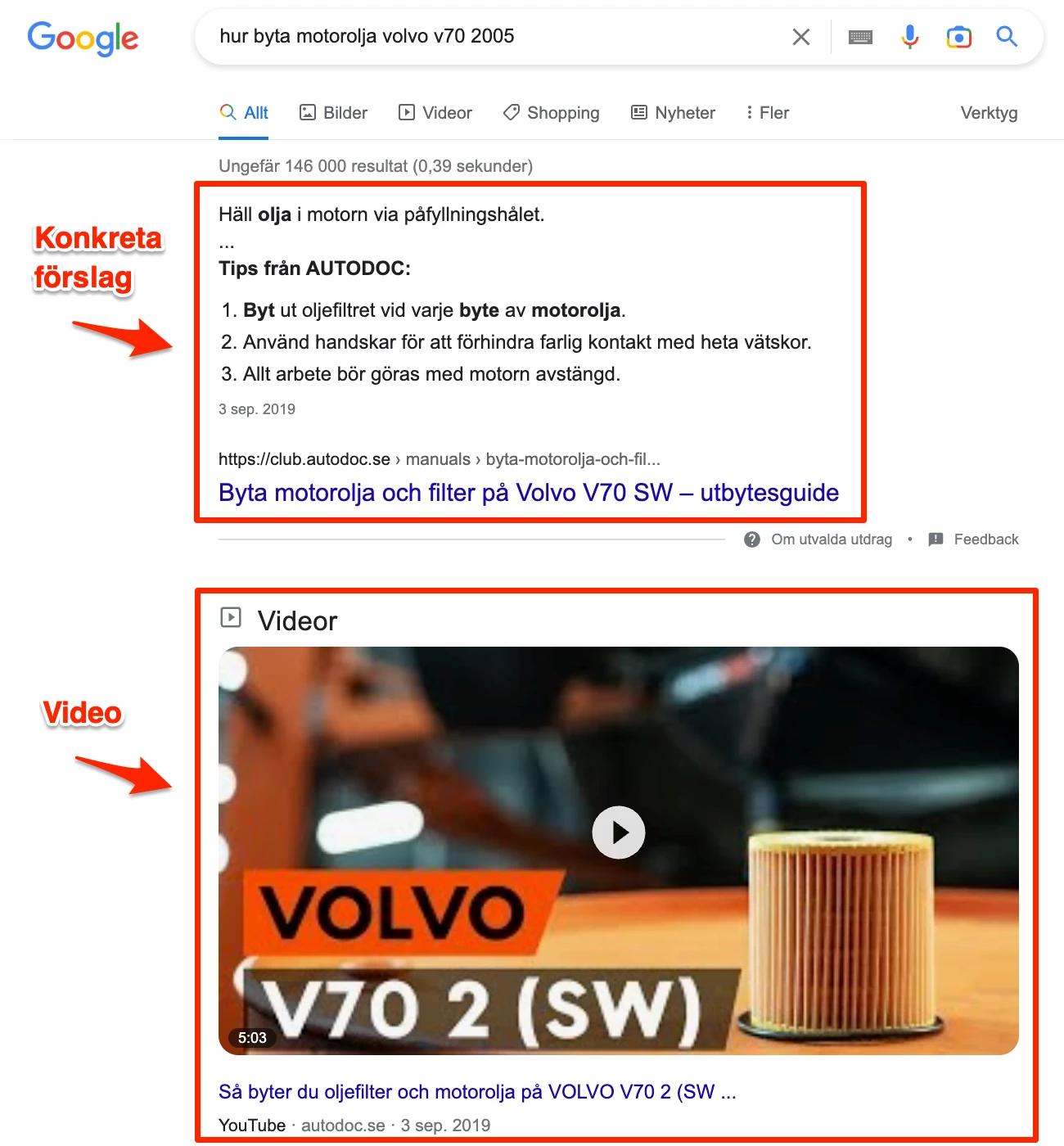
Here we again see the same company topping the search results. Autodoc creates authority within its industry with helpful content and guides in addition to a large range of products. Here they rank with two pages that give the searcher direct answers to their questions. The first search result is a bullet-point list of how to go about an oil change and the second result is an instructional video on how to perform the oil change. These are guides on how to solve a problem – you don't need to buy their product here, but once you're on this company's site the threshold to place your order right there becomes much lower.
Trying to rank for this search with a product page becomes almost impossible. Here the searcher demands quick and simple answers and Google knows this. Pages with clear, quick answers (preferably bullet lists, images, or video) are highly rewarded by Google as this is also something their users appreciate. But how do we convert visitors on these pages from searchers to customers?
Optimize content for conversions
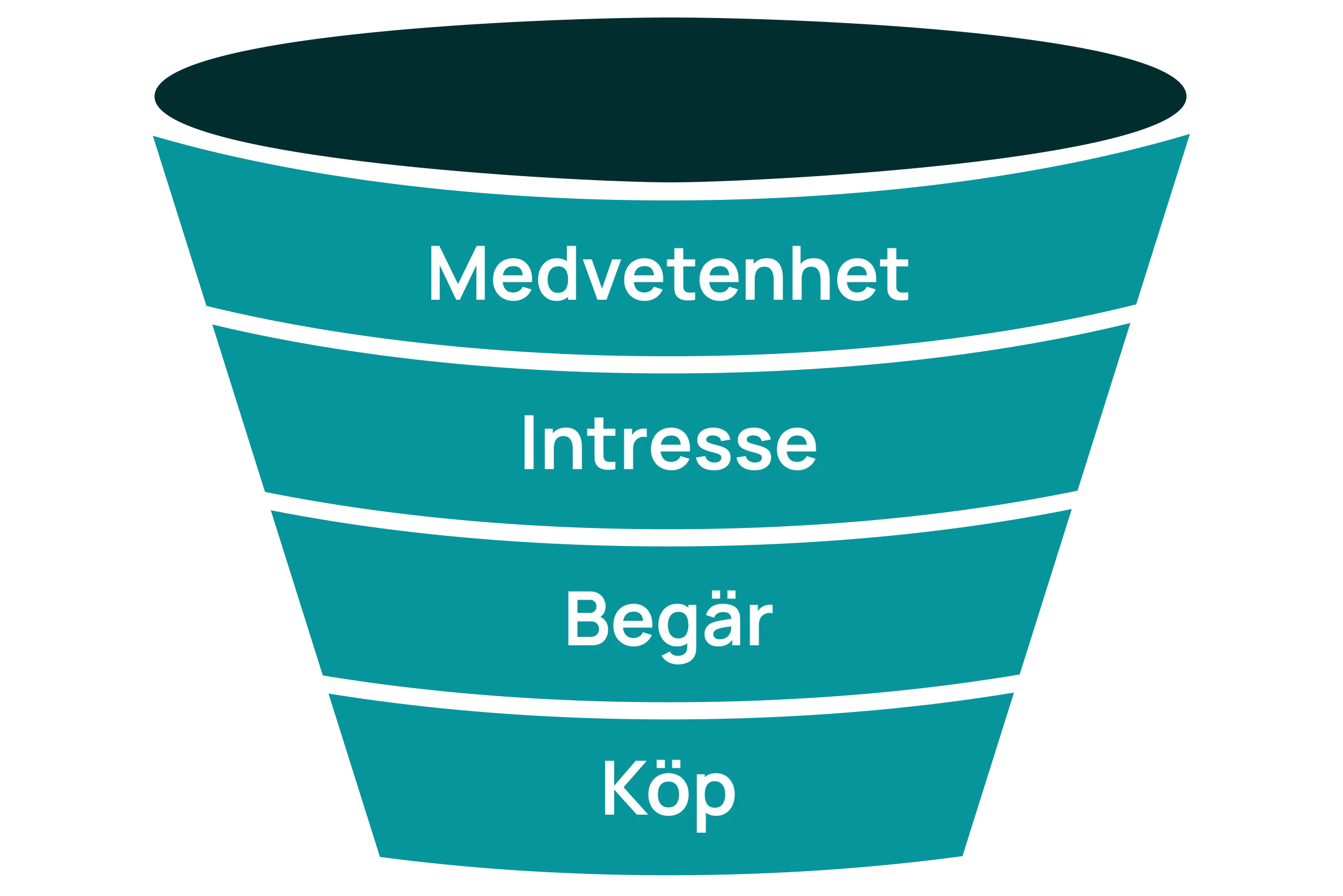
To convert visitors into buyers, you need CTA texts (Call-to-action) or buttons that link to conversion-focused content. You should think of it like a funnel where blog posts, guides, and similar pages play a major role in driving traffic to the site and then onward to specific offers and product pages.
- Awareness – potential customers discover your site and become aware of your company.
- Interest – potential customers become interested in your content and your products.
- Desire – potential customers move from interest to desiring your products.
- Conversion – your visitors move from being potential customers to becoming actual customers when they complete a purchase.
In the engine oil example above, it would for instance be appropriate to include links and product teasers below the article for the products that are necessary to purchase for the oil change. Keep in mind that the focus on such a page should be the guide itself and tips for the oil change, and that you can then link to relevant products further down the page.
Writing helpful content builds trust in your site and gives you authority within your industry, which in turn often leads to sales. Creating content that matches search intent with clear CTAs that move your visitors further down the conversion funnel raises the conversion rate on your site.
3 concrete SEO and CRO tips
- Optimize title and meta description
A conversion starts already in the search results. Make sure your title and meta description contain the keywords you want to appear for, but also think about making the text stand out a bit compared to your competitors. We want potential customers to click on your "ad" in the search results and not your competitors'. Feel free to include a CTA in the text. Read more about how you should think about titles and meta descriptions in a previous article I wrote on the subject. - Optimize content for mobile
Today, the majority of traffic to your site will certainly come from mobile devices. If your content is not optimized for mobile, you will miss important leads and conversions. Try to get the most important content or offer "above the fold" on mobile devices.
For a product page, this could for example be product specifications, price, shipping costs, reviews, and product images. This makes it easier for mobile users to quickly find the information they need and then take the next step toward a conversion. - Test and test again
Are you unsure whether the changes you want to make actually work? Then you can run A/B tests using tools such as Google Optimize. Unfortunately, the Google Optimize service will soon be shut down, but there are other alternatives on the market offering the same possibilities. With a CRO tool you can collect data and analyze the effect of your changes.
I hope this article was helpful to you! If it sounds complicated and you would like help with SEO and conversion work, we'd be happy to assist.