How much should an e-commerce project really cost?

Jakob Twedmark
VD & Rådgivare

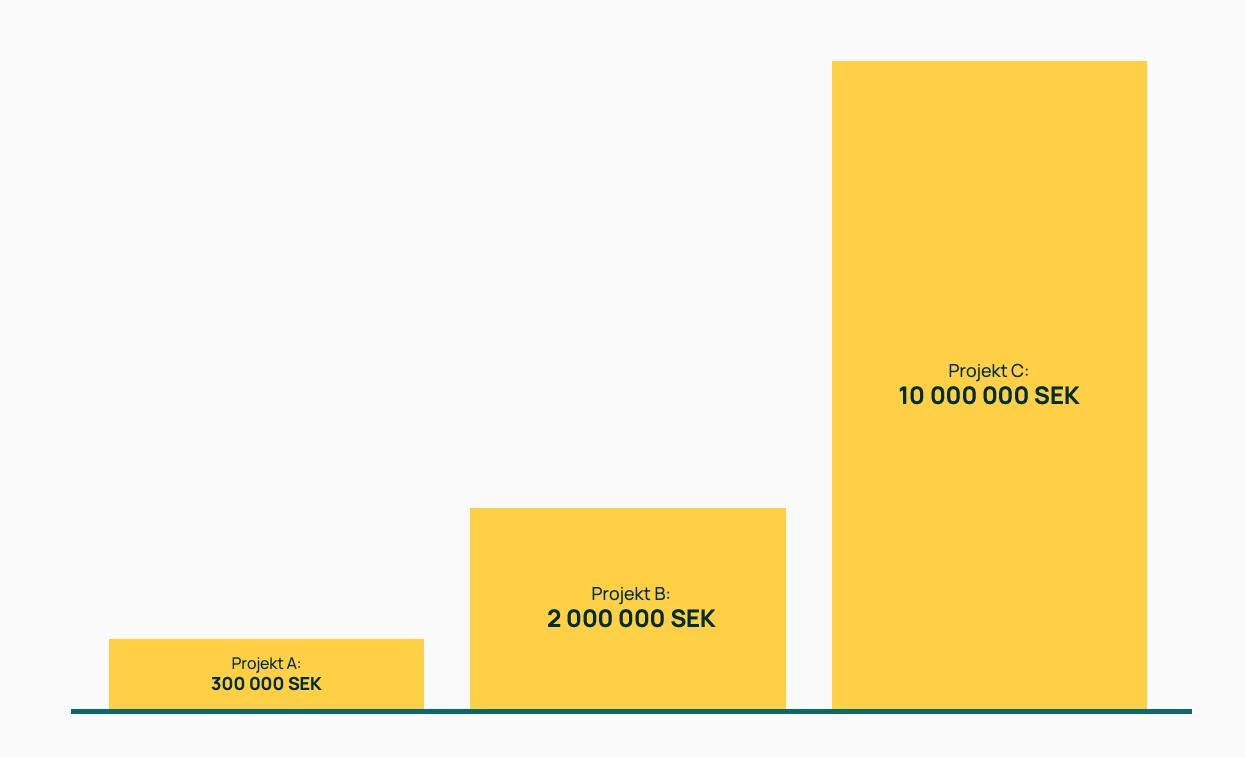
What separates an e-commerce project for 300 TSEK from one that costs 2 MSEK? And why do some projects cost 10 MSEK? In this article, we break down what drives costs in e-commerce projects.
Finally, we reason a bit about what it is worth, and why the same cost (and solution) can deliver a fantastic ROI for one company while being a financial disaster for another.
To put things in perspective, it can be useful to look at the different types of e-commerce platforms available.
1. Use a ready-made solution and customize the design yourself
By this we mean ready-made so-called cloud solutions (SaaS) where the customer does the work themselves.
Advantages:
- Quick to get started
- Low (or no) initial cost
Disadvantages:
- Requires a greater personal effort
- Difficult to customize and expand
- No personal advisory service offered
- You do not own the developed solution
2. Rent a proprietary solution from an e-commerce vendor
Several e-commerce vendors develop their own platform, which is rented out on a subscription basis. Design and other customizations are usually charged separately.
Advantages:
- Relatively quick to get started
- Personal advisory service and expertise offered
Disadvantages:
- Cannot switch vendor without rebuilding the solution
- The customer does not own the developed solution
- Limitations in terms of what customization options are offered
3. Hire a dedicated consultancy
An e-commerce consultancy typically develops its clients' solutions based on standalone e-commerce platforms, which can be either open-source or license-based.
Advantages:
- The solution is fully tailored to the client's business
- Personal advisory service and expertise offered
- The customer owns the finished solution
- Can freely switch vendor if the need arises
Disadvantages:
- May involve a higher initial cost than the above alternatives
In this article, we focus on option 3 (and a little on option 2).
What competencies are needed in an e-commerce project?
One of the great things about e-commerce is that it is such a broad field. There is so much to learn within marketing, design, strategy, technology, SEO, logistics, customer service, finance, analytics… the list goes on.
A successful e-commerce project requires competence across several of these areas. Even a technically focused consultancy should, for example, have an understanding of SEO and design in order to deliver a professional e-commerce site.
Some common competencies in a project team on the consultant side are:
- Project Manager
- Designer
- Frontend Developer
- Backend Developer
- Systems Architect
- SEO Specialist
- Strategist
- Tester
On the client side, the following roles typically complement the team:
- E-commerce Manager
- CFO / Finance Manager
- Content Producer
- Social Media Manager
- Administrator
In addition to this, a dedicated ERP consultant is almost always involved.
What activities are carried out during the project?
Regardless of project size, a certain amount of investigative work should always be done at the start. This is about the consultants needing to better understand the client's business in order to ensure that the solution being developed meets the existing needs.
The designer starts early by developing moodboards and design sketches for as many different parts of the solution as possible. This includes the product page (PDP - Product Detail Page), product listings (PLP - Product Listing Page), checkout, shopping cart, content pages, homepage, email confirmations, and more.
To ensure the solution achieves the best possible visibility in search engines (and does not lose its existing ranking), an SEO specialist is typically involved, working on keyword analysis, site structure, and technical SEO.
The systems architect's task is to ensure that the overall system structure is sound, and that integration flows between different systems are well thought out.
Developers are typically divided into "frontend" and "backend". Frontend developers ensure that the new site looks like the designs and provides a good experience for users. The technologies used here are primarily HTML, CSS, and JavaScript. Backend developers work deeper in the solution, building custom functions and integrations with external systems.
The strategist's task is to ensure, based on the client's stated business goals, that the new solution contributes to achieving those goals. This may involve marketing strategies, new functionality being developed, or ensuring that the new solution is efficient enough to use so as not to require excessive manual maintenance.
All systems naturally need to be quality-assured before a launch, and this is where testers come in and make important contributions, usually both during and at the end of the project.
Finally, someone is needed to ensure that the timeline is followed, that the project's finances are under control, that risks are managed proactively, and that obstacles and deviations are handled as they arise. These are the responsibilities of the project manager.
So… why do costs vary so much?
For the same reason that a tailored suit costs more than one taken straight off the rack, and that a unique dress worn on the red carpet costs more than one from H&M, the cost of e-commerce projects is largely driven by how much customization is required during the project.
Does really that much need to be customized? Most sites look roughly the same, don't they?
On the surface, many sites follow roughly the same structure — that's true. However, there is much that differs beneath the surface, as different businesses have different conditions and needs.
The design work alone in a slightly more ambitious project can require several hundred hours to meet expectations, while clients in other projects are satisfied with considerably less work.
An ERP integration takes varying amounts of time depending on how many flows need to be supported (orders, customer-specific prices, returns, partial returns, discount codes added after the fact, campaign management from ERP or e-commerce platform, complete order history on My Pages, etc.).
For e-commerce businesses where customers have a "search-driven" behavior, the internal search engine on the site needs to be customized to ensure that the right products are shown for the search phrases that are common in each respective market. Even on category pages/product listings, sorting is important so that the right products rank highly, based on relevance, profitability, and stock status.
It is also common today for an external email marketing tool to be integrated and for order data to be sent there, to enable segmentation and automated communications based on customer preferences.
In many cases, very specific functionality is also developed within the scope of the project. This can involve unique pricing logic, complex bundle products, or custom-configured products that the customer can build themselves.
Generally speaking, projects at the lower price level are usually built on ready-made design templates without major customizations, and any integrations that are made follow a fixed format with no possibility of adapting to the specific business. These solutions are also typically based on e-commerce platforms that are not configured much per customer, where the solution is somewhat locked in and can be difficult to grow with.
For an established e-commerce business that has grown to larger volumes, it also becomes important to plan for the actual launch moment, since it also means leaving another e-commerce solution. For example, it is essential to have done thorough SEO work, including so-called 301 redirects, so that visitors via Google are not met with 404 pages, which can quickly lead to reduced traffic from search engines.
Orders that have been placed in the old platform need to be manageable for delivery via the new solution. Sometimes previous orders also need to be migrated to the new solution, and here too it is important that this work is done in a controlled manner.
In short, a larger e-commerce solution with many products brings with it a greater amount of work to replace, and this should be reflected in the project cost.
A low price tag can be an indicator that the vendor has not understood the complexity.
Our projects often carry a price tag of between 1–1.5 MSEK, and that price is based on the above activities being carried out to the extent required for the specific business.
So, what makes some projects cost 10 MSEK or more?
At this scale, the client is almost always a larger retail chain, with complex needs and omnichannel sales through both e-commerce and multiple physical stores. The solution in question is then often a larger headless architecture where 5–7 different core systems together handle advanced needs within PIM (Product Information Management), e-commerce logic, merchandising (search and categorization), customer loyalty, and marketing tools for various communication channels such as email and SMS. In some cases, the client is also switching ERP at the same time.
It is therefore a matter of several different projects converging to ultimately launch a new solution that in practice handles more than just e-commerce sales, but also in-store sales and, not least, customer communication.
This then becomes an extensive project that places high demands on both vendor and client. As a client, you should in this case have a high level of technical understanding, since the solution being delivered is complex and demands a lot from a buyer — both during the project and in the ongoing work after launch.
What is a reasonable cost for you?
A newly started e-commerce business without prior sales should, in my opinion, start with a simple solution, such as Shopify. You will admittedly have to do a bit more yourself, but the solution is affordable, efficient, and leaves more money for marketing. Once volumes have increased, however, it may be time to look at something a bit more customizable.
An established B2B business looking to add e-commerce sales for its customers should look at solutions that have a PIM system (Product Information Management), either built-in or external. This is to facilitate the management of large amounts of product information. It also needs to be possible to integrate with your ERP system, to ensure that customer-specific prices can be used in e-commerce and that all order history can be displayed to the customer. There should also be the possibility to build custom functionality. Projects that meet these requirements typically start around 1 MSEK. (Ready-made e-commerce modules from ERP vendors sometimes attract with a low price tag but rarely work satisfactorily for the customers expected to use them.)
An e-commerce business already in full swing with its sales should choose a solution that can be integrated with other systems via APIs. It also needs to be easy to manage 301 redirects and to work with SEO on the site. If it is a retailer selling multiple brands (and thus likely has a large assortment), a PIM is very helpful here as well. Within B2C, design is also typically more of a priority, as is the ability to manage the assortment based on various parameters. These projects typically start at 1.5 MSEK, but can, as mentioned above, carry a significantly higher price tag.
To determine whether the price is right for you, I think you should put the cost in relation to the business goals you have set. If you have a growth journey ahead of you and believe that the intended solution will help you reach those goals, then it is likely wise to invest a portion of your budget in a well-built and flexible e-commerce solution that covers your needs for a number of years ahead.
It can also be useful to weigh in the cost (or the lost revenue) that comes from a poor solution. What obstacles are created by being "stuck" in a system that is slow for users, does not present the right products at the right time, is inefficient to manage information in, or that cannot be integrated with external systems that may become relevant for you?
In addition to the initial project cost, there should also be a budget for both ongoing maintenance and for further development of the solution.
In the end, of course, every business must decide for itself what the right cost is based on the delivery it expects. I hope this article could contribute a few aspects to take into consideration.