Litium vs Magento - Prices and 7 Key Differences

Jakob Twedmark
VD & Rådgivare
A successful e-commerce business places high demands on the systems used, and there are more options to choose from today than ever before. That is why we have compared two platforms that are popular both in Sweden and internationally: Litium e-commerce and Magento. These platforms have a built-in CMS, but if you are curious about e-commerce with a CMS of your choice, you should read our article on headless e-commerce.
Information: Motillo is a Premium Solution Partner with Litium and develops e-commerce solutions based on this platform. For this article, we have conducted online research using Magento's documentation and various articles in order to compare these two platforms.
A comparison of two popular e-commerce platforms: Litium and Magento 2 Commerce (formerly Enterprise Edition)
Litium: a cloud-based e-commerce platform with a built-in PIM system
Swedish Litium's journey started as far back as 1998, but it was not until 2013, when the company's consulting division was spun off, that the development of the platform really took off. Today, 250 customers use Litium's platform, including Jollyroom, Adidas, Teknikmagasinet, and SEAB.
Litium's e-commerce platform consists of three parts:
- Digital Marketing
- E-commerce
- PIM - Product Information Management
Magento: the world's most widely used e-commerce platform for the mid-market
Large numbers of sites around the world are based on Magento Open-Source. More recently, Magento 2 Commerce has also been launched, offering extended functionality when it comes to content management, campaign management, personalization, search features, B2B, and performance. The base version of Magento Open-Source lacks several of the features that Litium has, so in order to make a fair comparison, we compare Litium against Magento 2 Commerce.
Product management: how does this work in practice in Litium and Magento?
One of the most important aspects for an e-commerce retailer relates to how product information can be managed. Each product needs to be enriched with descriptive texts, images, and product attributes. It needs to be categorized and presented attractively on the site.
In some cases, some information can be retrieved from a business system, but this information is usually not tailored for a customer and needs to be made more readable, sales-oriented, and information-rich.
This has opened up the market for PIM systems (Product Information Management). A PIM system has two important tasks: to simplify the management of large amounts of product information — and to direct this to the right channels.
Examples of channels can be: e-commerce solution, printed product catalogue, marketplaces, external systems & apps. By centralizing management in one place, the right information can be distributed to all channels simultaneously.
Litium has a built-in PIM system
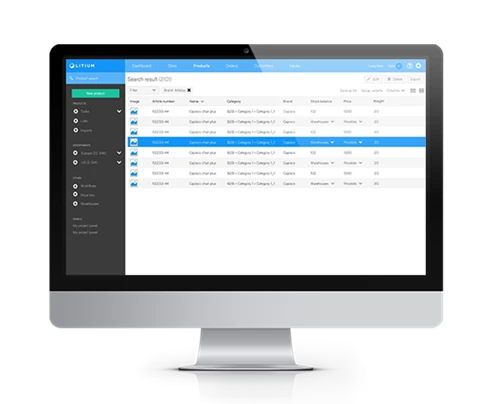
Something unique to Litium is that the platform includes a complete PIM system. What does this mean in practice?
- Manage products in one place — control which channels they appear in
Products are at the centre, and the editor then controls which channels they should appear in. A channel can be the e-commerce store (or selected markets), external price comparison sites, a product catalogue — or something else. - Work with workflows
A central part of a PIM system is the ability to set up rules for when products need to be handled by an editor. In Litium, this can be controlled by a wide range of parameters: texts in a certain language are missing, category is missing, image is missing, belongs to specified brands, etc. The workflow then instructs the editor on what handling is required for the product to be marked as Ready. Products can either be edited directly in the system or by exporting to Excel. - Automatic image linking
Images uploaded to Litium are automatically linked to the correct products as long as they have the article number in the file name.
Magento lacks a PIM, but has a smart feature for creating product variants
Magento has no PIM system, and instead relies on the user searching the product catalogue themselves to find products that need supplementary information.
Adding product attributes and images for variants in Magento
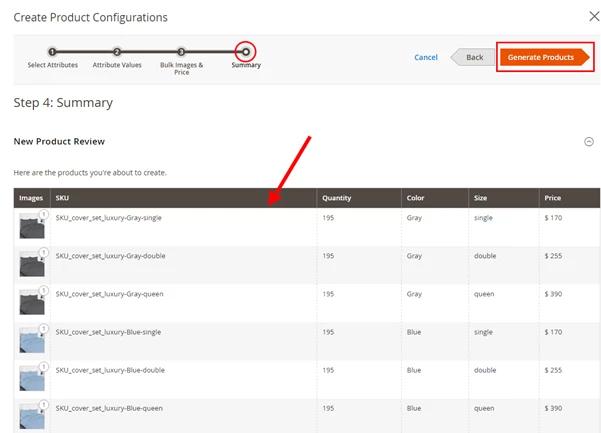
Magento has a convenient step-by-step guide for adding product variants. By selecting from pre-defined attributes and values, all combinations are created. It is also possible within this flow to choose to upload images shared across all variants or unique per combination.
In Litium, the editor needs to create each combination manually. If an integration with a business system exists, this is not a problem in practice since variants are then created automatically, but if it is absent, this can easily become time-consuming when dealing with many products.
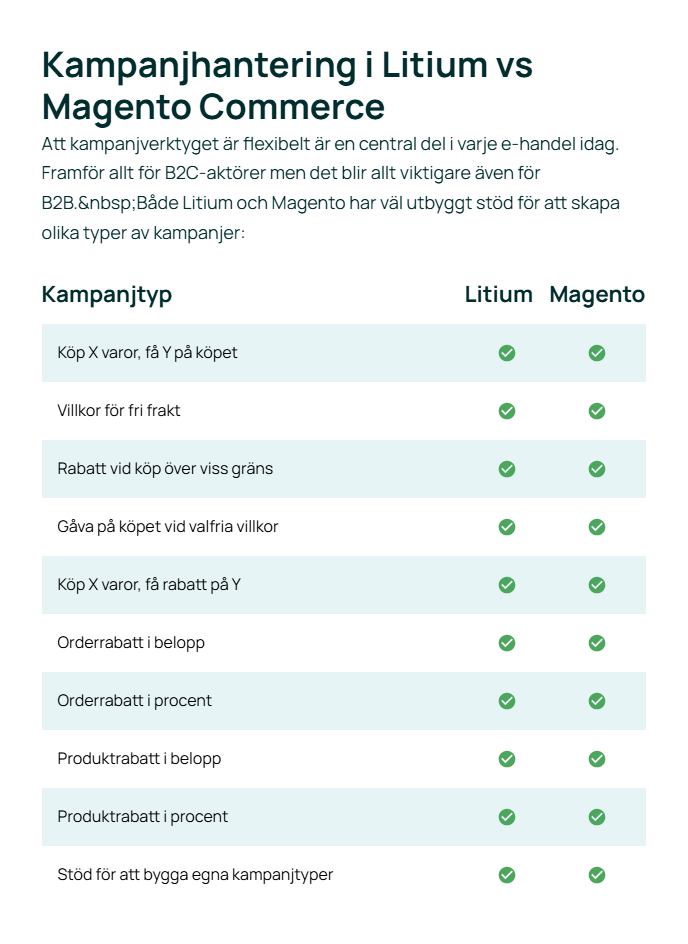
Content Management (CMS) in Litium vs Magento Commerce
Through Magento's acquisition of Bluefoot CMS, which is included in Magento 2 Commerce (not Magento Open-Source), a powerful tool is offered that allows editors to create content in a flexible way.
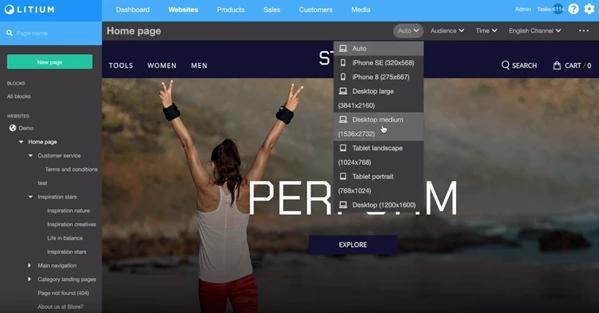
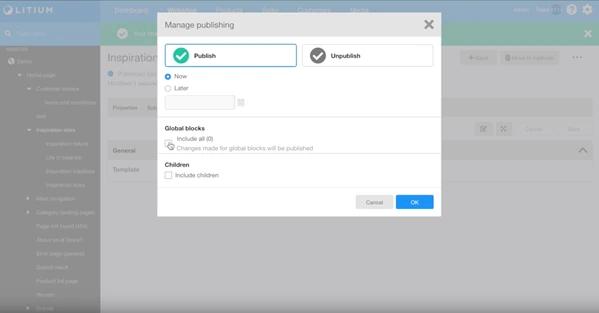
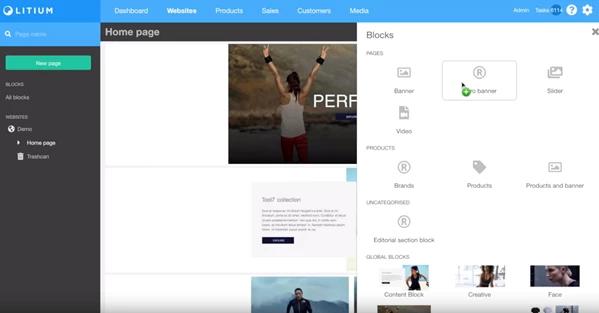
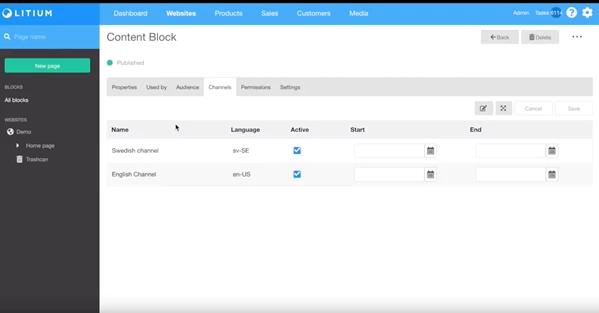
Litium launched in version 7 (autumn 2018) a completely new CMS with drag-and-drop functionality, so both platforms have good conditions for allowing editors to work freely with content.
Magento Page Builder
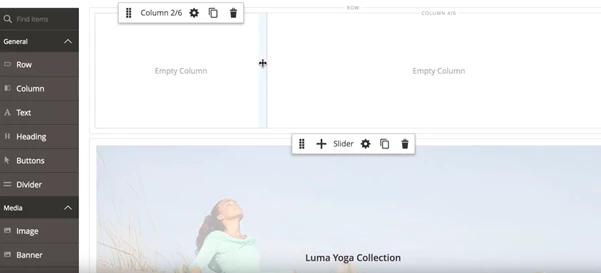
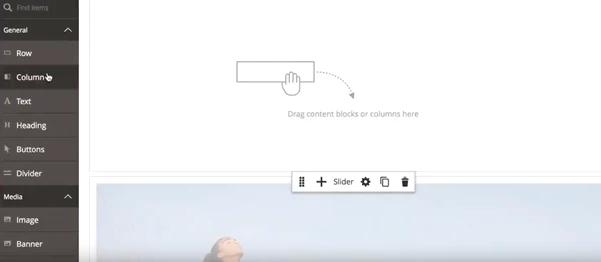
Magento's CMS is built on a grid management system where the editor adds rows and divides them into columns of any size. Different types of content elements can then be dragged into each column:
New CMS in Litium 7
Litium has chosen to let the different content elements (known as Blocks) control the appearance of each row. It is therefore not the editor who controls column width in the same way — this is defined in advance when the different block types are created. Which option is preferred is largely a matter of taste. Magento offers greater freedom, but this also means more steps for the editor when creating content on each page.
This is what it looks like in Litium:
Personalization and customer segmentation in Litium vs Magento Commerce
Just as a successful Email Marketing strategy is built on dividing recipients into smaller groups in order to send targeted messages, a successful e-commerce store is built on ensuring that the content and campaigns presented are also targeted at different audiences.
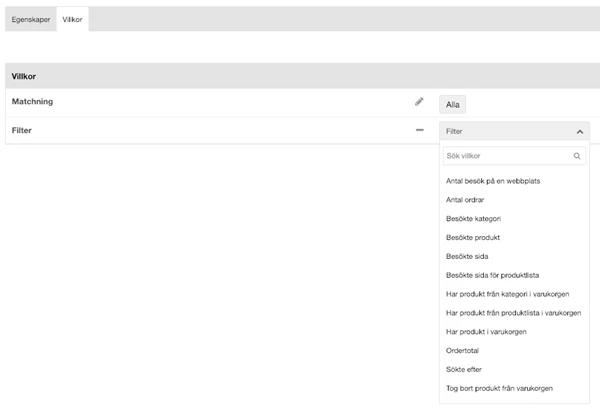
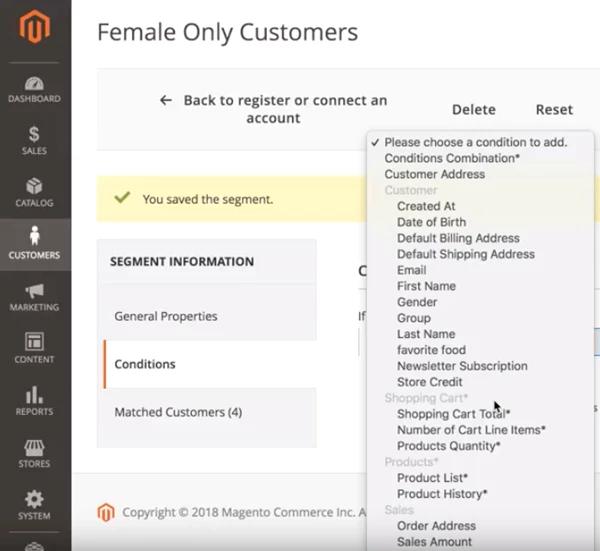
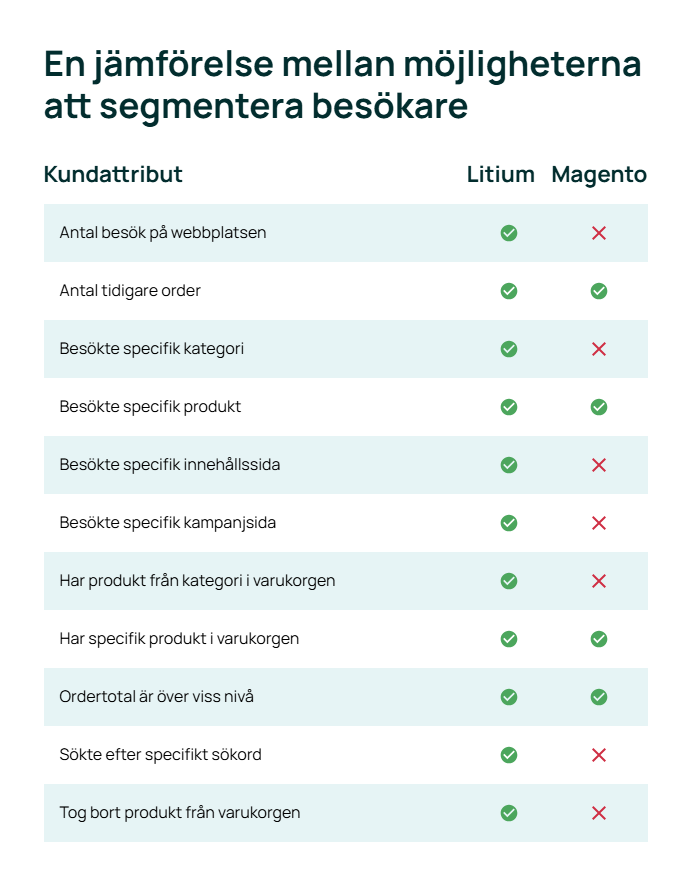
Both Litium and Magento support segmentation based on customer data (for logged-in customers) such as company affiliation or order history, as well as attributes that control behaviour (including non-logged-in visitors), e.g. that the visitor has viewed a specific product or has items worth more than X in the shopping cart.
Segmentation in Litium
Segmentation in Magento
Handling multi-currency in the different platforms
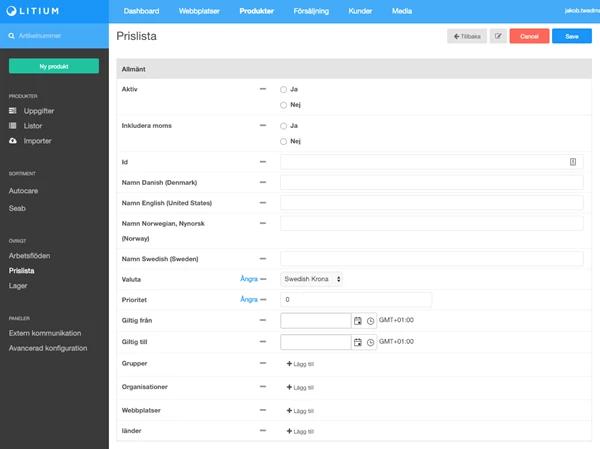
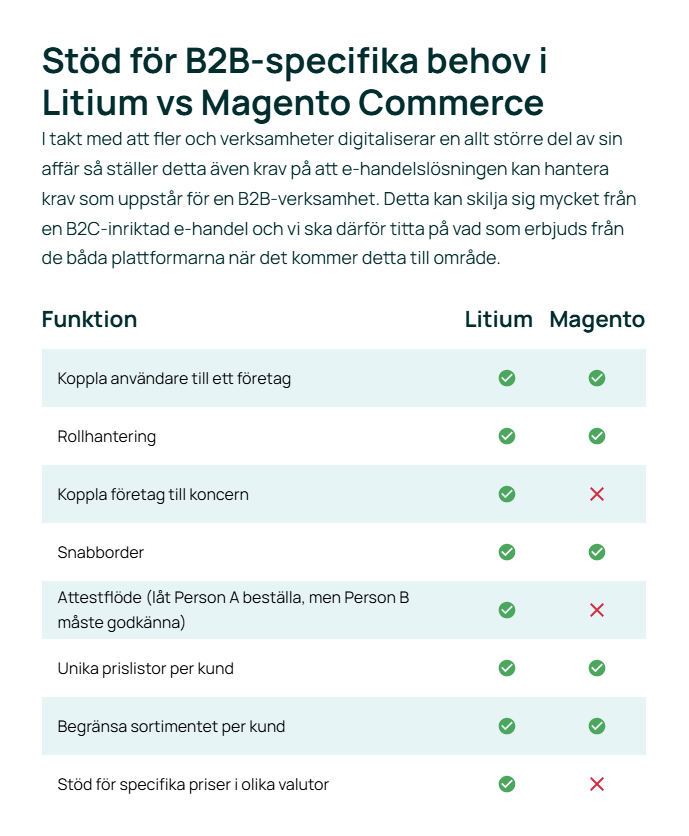
One difference worth considering is that the two platforms handle price lists and currencies differently. In Litium, this is managed through different price lists, meaning there can be a price list in SEK and another in EUR. In each price list, prices are managed specifically in that currency. This makes psychological pricing easy to handle — a sweater can, for example, cost 995 SEK and 99 EUR.
In Magento, a currency conversion is used that is applied to the entire product range. Prices are entered in a control currency and are then automatically converted based on an exchange rate. There is no option to set specific prices in different currencies.
Options for managing different prices for different customers
In Litium, this is handled through the concept of Price Lists, and in the same way that different currencies mean different price lists, customer-specific price lists can also be managed. Each price list is prioritized and linked to a specific customer, ensuring the correct price is displayed for those customers.
In Magento, this is based on something called a Shared Catalog, which means a "copy" of the product catalogue is created. This can then be linked to a specific customer. Prices are then managed anew for that customer within this catalogue.
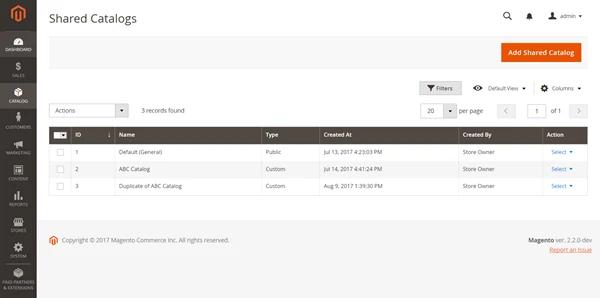
Image: Shared Catalog in Magento