Pros and cons of headless e-commerce

The first e-commerce platforms that emerged typically contained everything needed to run an online store, which at the time was not much more than the ability to add products, set prices, and accept payments. As e-commerce has evolved, specialists have emerged in a multitude of areas: payments, shipping, marketing, content management, and customer loyalty (to name just a few). It can therefore be a lot to ask of a single e-commerce platform provider to be the best in every individual branch.
This has created the need to integrate different systems with each other, so that everyone can create the combination that suits them best. A bit like being able to pick your own pick-and-mix sweets instead of buying a pre-made bag of Saturday mix.
Some e-commerce platforms offer no frontend at all (simply put: design and content management), and it is primarily these platforms that are usually referred to as headless — especially when offered in the form of "multi-tenant SaaS" (Software-as-a-Service), where all updates are managed by the platform provider.
However, there are examples of platforms offered both in a headless configuration and with the option to use a built-in CMS. We will return to this.
Choosing an e-commerce platform can certainly be difficult. Looking at which platforms the 100 largest e-commerce companies in Sweden use, there is a great variety — and it is perhaps no stranger than the fact that many different car models drive on our roads. Even if many have the same goal, the conclusions differ, perhaps due to a combination of objective and subjective choices. That is why it is important to think about what matters most for your own future journey.
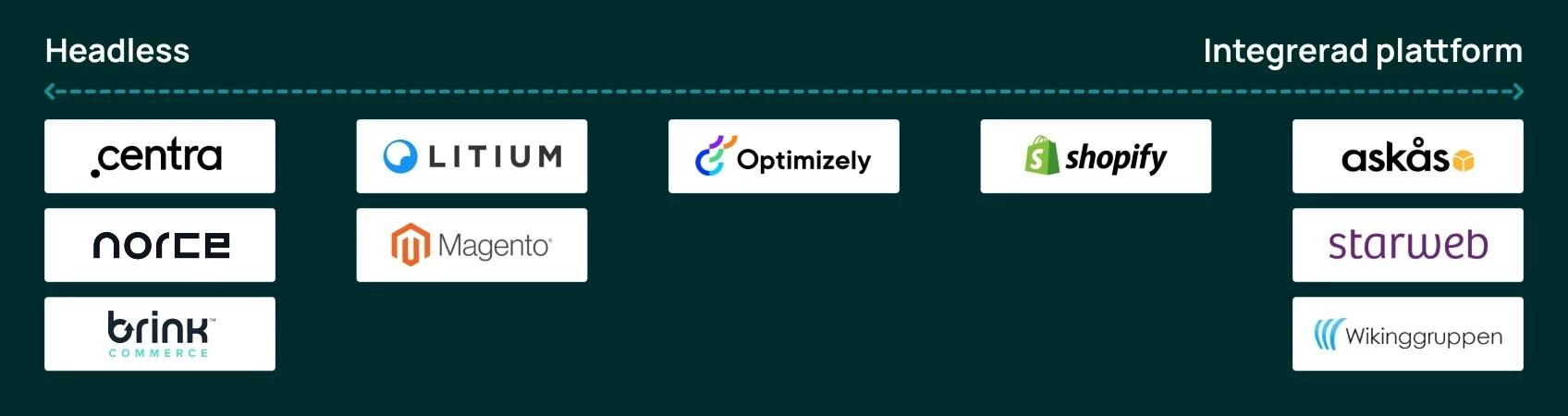
Two relatively common headless platforms in Sweden are Centra and Norce. Centra specialises in fashion and offers an out-of-the-box solution for digitalising the B2B/wholesale flow for brands selling to stores and retailers. Brands that also want to sell directly to consumers can do so by integrating with any CMS via APIs.
Norce is a platform with a somewhat broader focus and has customers in retail, brands, and B2B alike. Their solution has a built-in PIM system and can also be supplemented with an automatic price adjustment engine that can adjust prices daily in relation to competitors. Norce can advantageously be combined with a headless CMS such as Storyblok.
Some platform providers now offer their solutions in a Headless Edition, where the built-in CMS does not have to be used, and where all functionality is made available via APIs to enable external integrations. Among these is Litium, whose Commerce Cloud can be used either with the integrated CMS or with any external one.
Adobe Commerce (formerly Magento) should also be placed in this category, as it is sometimes used in a headless configuration.
Optimizely primarily focuses on offering a complete suite of products within its solution, but is highly adaptable to needs and also falls within this category.
Here we find the platforms primarily designed to be configured and customised by the customer themselves, or with the help of a partner. These include Shopify, BigCommerce, and others. Generally very few development hours are spent on these projects; the work is about configuring the solution within given parameters and installing add-ons.
Finally, there is a segment with plenty of providers in Sweden: Askås, Wikinggruppen, Starweb, and many more. What they have in common is that only the platform provider's own consultants work on customer customisations of the solutions. The advantage is that they have a good grasp of what the platform can and cannot do, but a disadvantage is that resources and access to developers can be limited, and that it is not possible to change development partner without also changing platform.
Freedom of choice is usually cited as the first advantage in these contexts, but I think it is relevant to start from the problem that needs to be solved.
The reality for an e-commerce business today is that competition is tough in most industries and that customers' expectations of the buying experience from start to finish are very high. This means that being fairly good is not enough. An e-commerce business must be excellent at everything from product range, search capabilities, customer service, customer communication, and delivery precision. If one and the same system can solve all of this — great! But in reality, that is rarely the case. Some subsystems may already be in place and cannot or should not be replaced. And in some cases, the business has specific needs that only a particular system can handle.
If the road ahead in terms of future sales channels is also unclear, more and more factors begin to argue for investing in a flexible and adaptable solution — and then I think you should take a closer look at platforms in the Headless Pure-Players or Hybrid-Headless segment and evaluate their functionality and development partners.
Every coin has two sides, and headless e-commerce is no exception. Since a headless architecture by definition will consist of multiple different providers or systems, the overall responsibility does not lie with any one of them — it lies with you and your development partner (whether that is an external consultancy or an internal development unit). Headless does not mean plug-and-play with an unlimited number of systems; it generally requires more development time than a solution where the parts are integrated from the start. This applies both to new development and ongoing maintenance.
In general, it can be said that headless e-commerce means you can do anything — but at the same time, it is you who has to do it.
We ensure that strategy becomes reality, that technology supports the business, and that marketing delivers measurable results.