Technical discovery and platform selection — how to find the right way forward
Digital solutions are more complex today than ever, and the range of platforms, services and technical setups is constantly growing. Sometimes the right way forward is to buy in or rent a ready-made solution. Sometimes it's better to build something entirely your own. The hard part is rarely finding a solution that works, but finding the one that suits your specific business, your customers and your ability to manage the solution over time.
That's where our technical discovery comes in. The aim is to clarify and challenge your needs, and translate them into a technical solution you'll benefit from for years to come.
Why carry out a technical discovery?
The platform market in Sweden and the Nordics is highly fragmented today. There are more than 50 e-commerce platforms to choose from, and it can be hard to tell what sets them apart.
We've worked with e-commerce for both B2B and B2C for close to 20 years, which has given us good insight into both trends and the concrete differences between various solutions.
Our technical discovery builds on all of our experience and gives you a shared, fact-based foundation to make decisions on. It reduces the risk of expensive do-overs later in the project, and makes it considerably easier to compare quotes fairly.
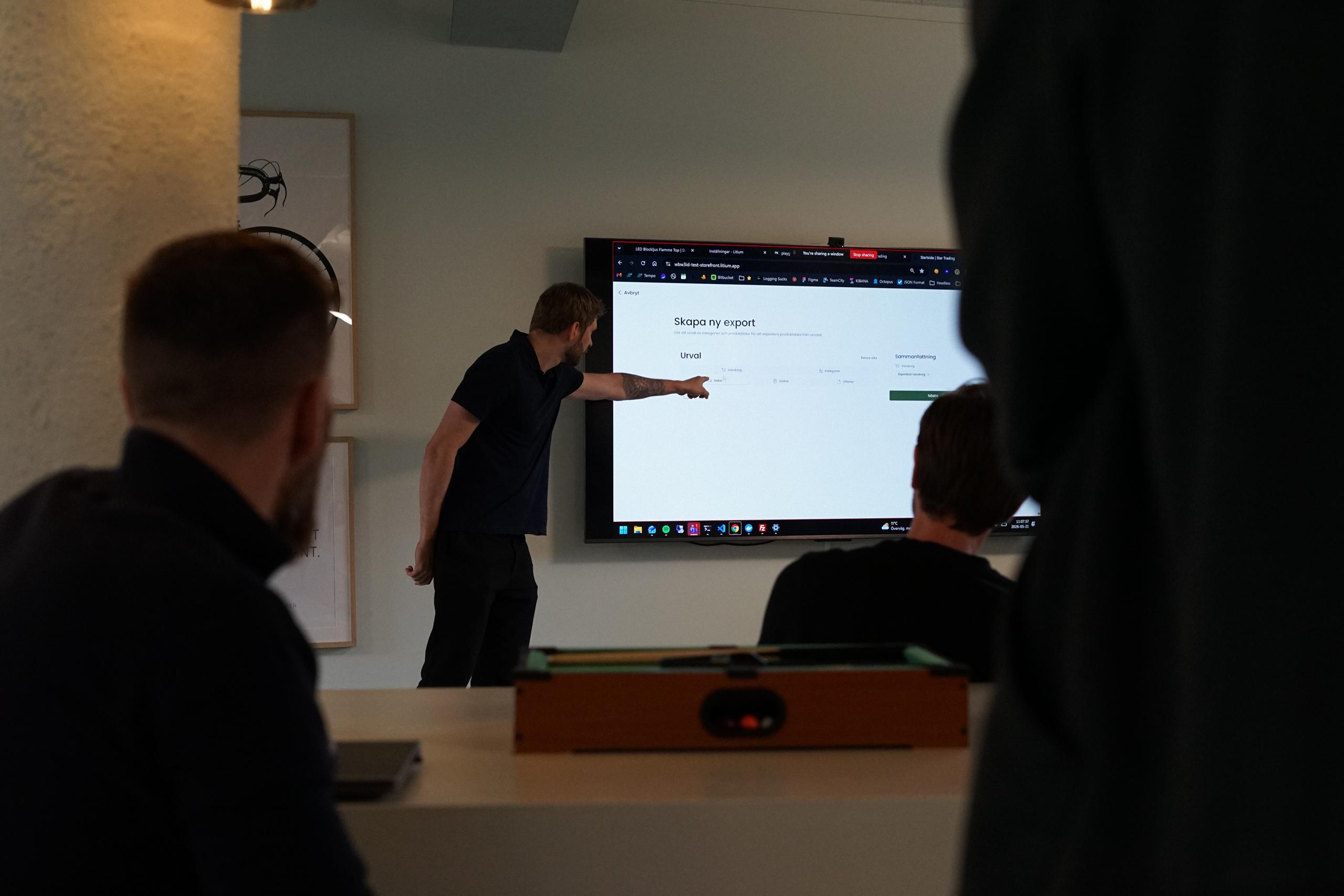
What our technical discovery and platform evaluation covers
The content is always adapted to your situation, but there are a few recurring areas we always recommend:
- Business and effect goals. What should the solution accomplish, for which customers, and how should it be measured?
- Current state. Which systems already exist, what works well, and where does the friction sit today?
- Target groups and usage scenarios. A technical solution affects several people and roles, both internal and external. We therefore need to make sure the new solution meets the needs of everyone affected.
- Integrations. ERP, PIM, payment solution, marketing tools, inventory system. Which flows need to be in place, and what do they look like?
- Risk analysis and prioritisation. What's critical from day one, and what can come in a later phase?

Four different types of e-commerce platform
Once the picture of needs is clear, we arrive at a technical choice of direction. Simplified, there are four main tracks, and all four can be exactly the right choice depending on your circumstances.
- Ready-made SaaS solution (do most of it yourself). Low initial cost, but often limited scope to customise and extend. Often suits smaller businesses or newly started sales.
- Rented platform from an e-commerce provider. You get the solution up and running relatively quickly and have access to advice, but you're more tied to a specific provider and their pace of development.
- Custom-built solution via a consultancy, based on a standalone platform. Gives the highest possible degree of customisation; you own the solution and can change provider when needed. Requires a higher initial investment, but also gives a longer lifespan and better scope to grow.
- Headless or composable commerce architecture. A modular solution where several specialised systems (e-commerce engine, PIM, search, customer loyalty, marketing) are assembled into a whole. It opens up major possibilities but also places slightly higher demands on you as the client, both technically and organisationally.

We start from your desired budget when we evaluate the options
The cost of an e-commerce project is driven above all by how much needs to be customised: design, ERP integration, pricing logic, search, category management and any migrations from an existing solution. As a rule of thumb, projects based on established platforms with client-specific customisations often land around SEK 0.5–1.5 million, while larger, more complex projects can require a considerably bigger investment. A very low price tag is rarely a good signal; it usually means the provider hasn't understood the complexity.
Beyond this, it's important to factor in ongoing costs after launch. These can consist of several parts: fixed and variable licence costs, operating costs, a support agreement for the chosen consulting partner, and ongoing work on maintenance and further development.
What matters isn't the absolute cost but its relationship to the business goals. The same solution can be an excellent investment for a company with a clear growth journey and an expensive misinvestment for another.
When we help find the right solution for you, we always start from your desired budget, to make sure you invest neither too little nor too much given your needs.

The result is a basis for decisions you can act on
When the discovery is complete, you have a documented basis describing needs, recommended technical direction, integration architecture and a realistic cost picture.
You can then feel confident that the choice you make is clearly anchored in your needs and objectives.
A few of our customers
From fast-growing e-commerce businesses to established industrial companies. We work with customers across different sectors and sizes, and our collaborations often run over a long time.


Becoming the leading digital growth partner in the Nordics
We turn strategy into reality, and combine technology with marketing to help your business grow faster.