Skip to content
Motillo

Introduction to Litium - the popular e-commerce platform for B2B and B2C
Introduction to Litium - the popular e-commerce platform for B2B and B2C

Litium is one of the Nordic region's most established e-commerce platforms and a common choice for medium-sized and large companies in both B2B and B2C. For those evaluating platforms ahead of a new e-commerce project, it is worth understanding not only what Litium can do from a functional standpoint, but also how the solution is implemented and maintained together with certified Solution Partners – something that affects both quality, delivery time, and long-term security in a Litium project.
What is Litium?

Litium is one of the Nordic region's most established e-commerce platforms, founded in 1998 and today listed on Nasdaq First North Growth Market. The platform is built to help B2B and B2C companies accelerate their digital sales, scale quickly and reach new markets, while creating a market-leading online customer experience. As a Premium Solution Partner to Litium, Motillo continuously works with companies such as Öhlins Racing, Kellfri, Cyberphoto and Matt-tema, all of which run their digital commerce on the platform.

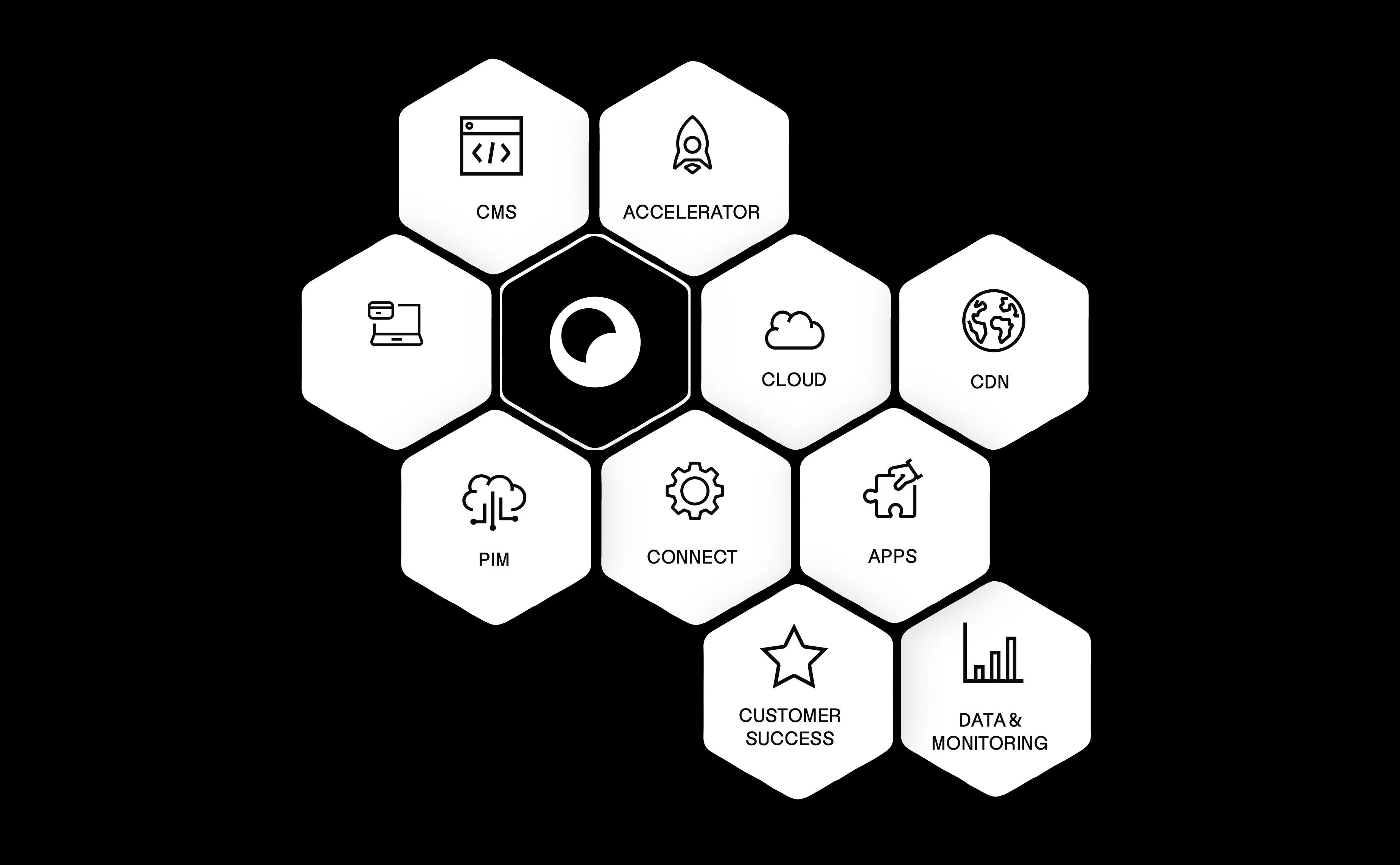
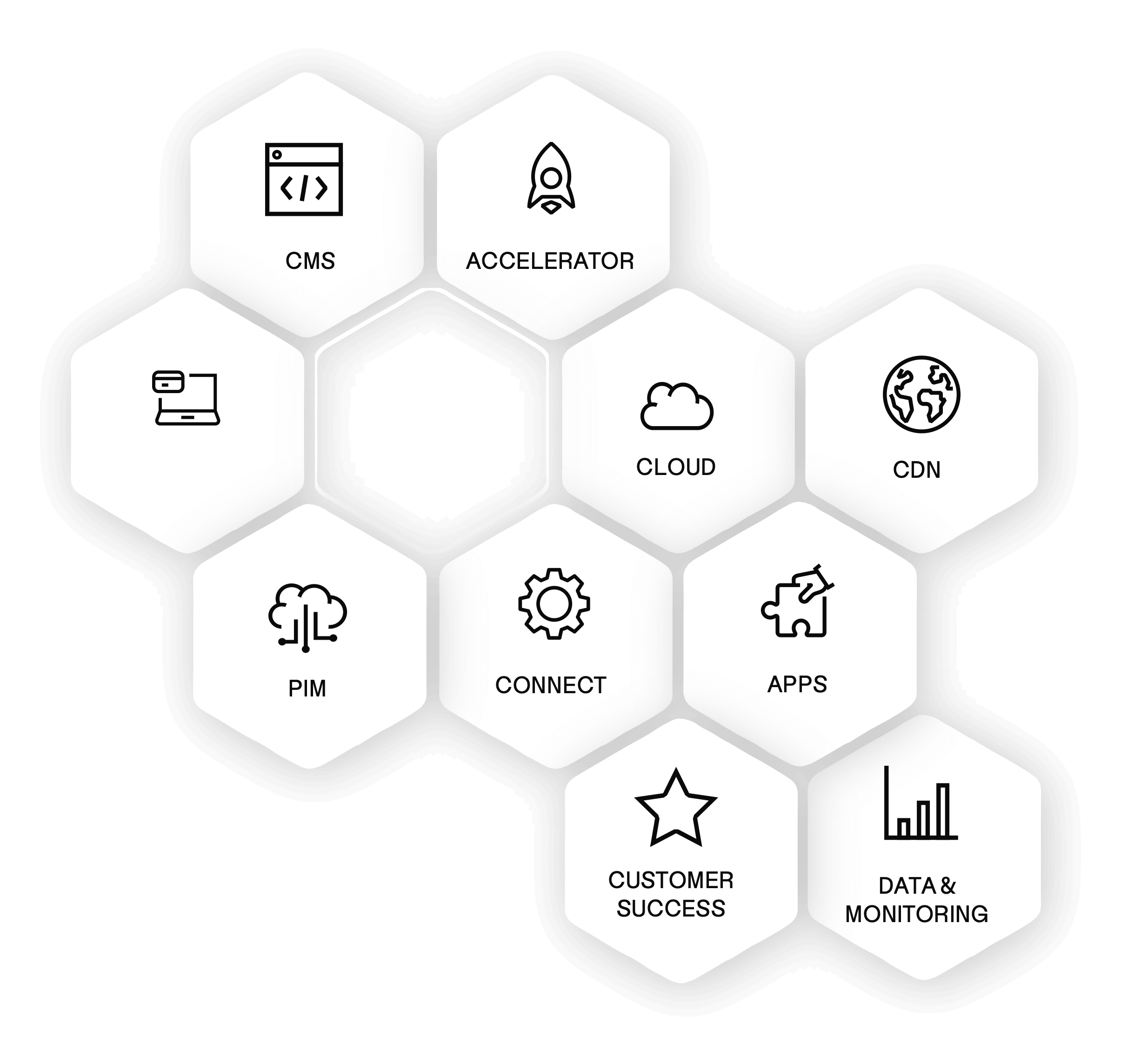
At its core, Litium is delivered as an integrated platform with three main components: an e-commerce system, a CMS for web publishing, and a PIM system for product information. You can use the full suite together for fast time-to-market, or pick individual parts and combine them with other systems depending on what the business already has in place.

Who is Litium for?

Litium is primarily aimed at mid-sized to large e-commerce companies within both B2B, B2C and the hybrid model B2B2C, where a company sells to another company that in turn sells on to the end consumer. The platform is particularly strong for companies that need to combine complex B2B flows — customer-specific pricing, own invoicing, multi-level purchasing organisations — with a modern, consumer-adapted B2C experience in the same solution.

According to Litium's own report Nordic Digital Commerce in B2B 2026, 81 percent of Nordic B2B companies now have digital sales channels, digital sales account for an average of 31 percent of revenues, and 58 percent plan to increase their budget for digital commerce in the coming year. This is precisely the type of company — well-established B2B businesses taking the next step in their digital maturity — that Litium is built to support.

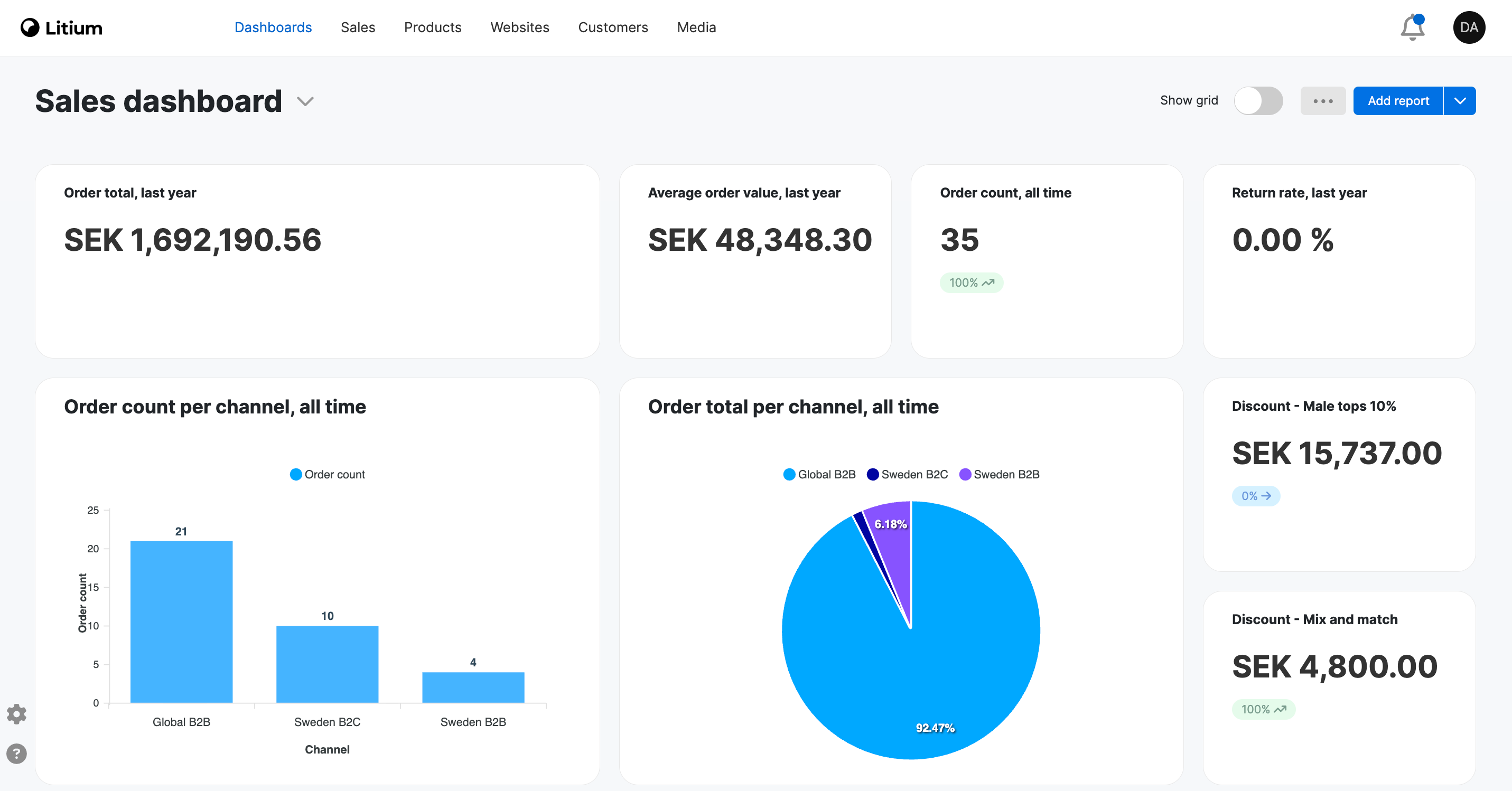
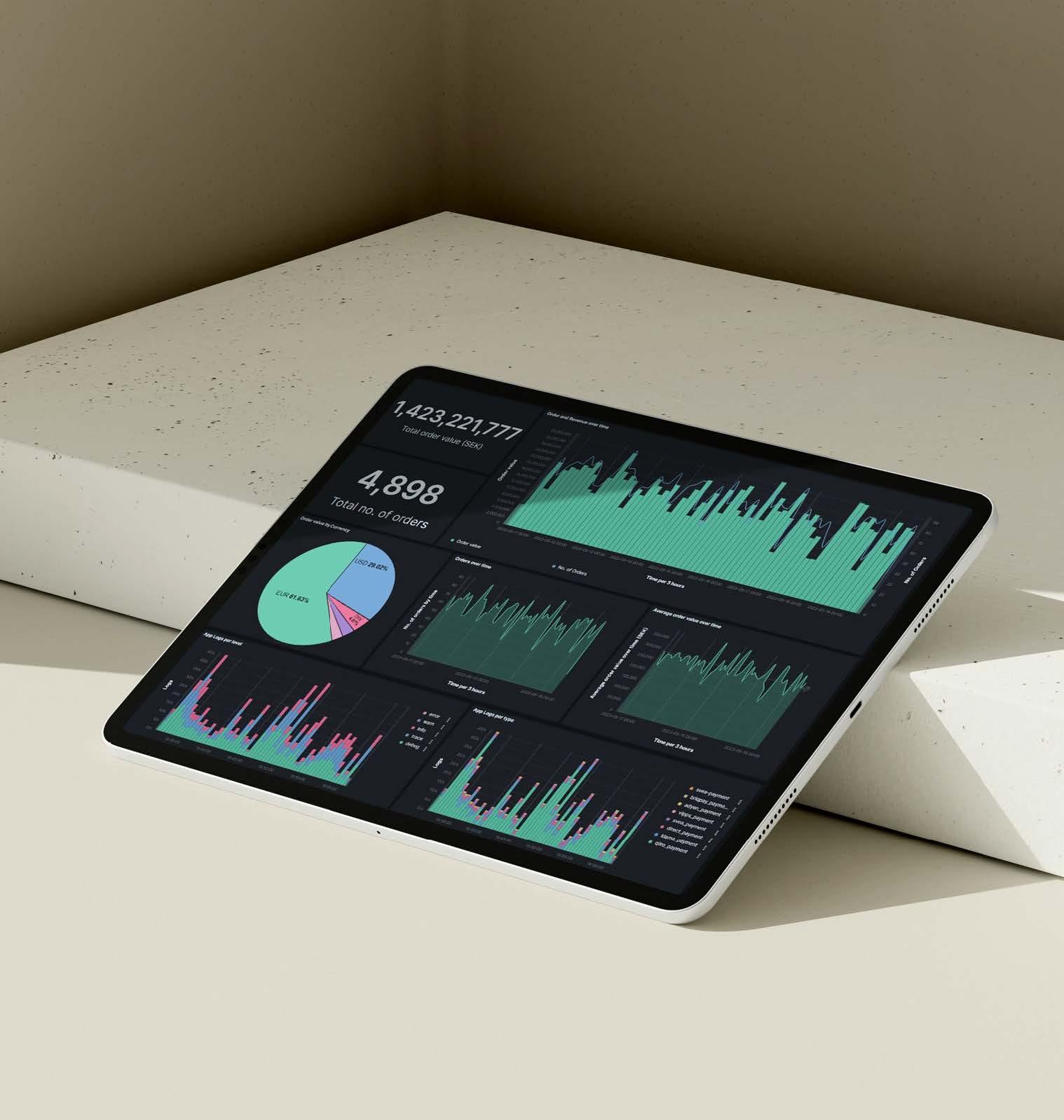
Sales Dashboard i Litium

Core functionality in Litium

Litium brings together content, product data and sales in one and the same platform, making it possible to work quickly and keep everything updated while maintaining a consistent customer experience across channels. Some of the most central functional areas are:

  • PIM system – management of large volumes of product information, variants, bundles and relationships, with support for multiple languages and markets, enabling product data to be distributed consistently to the webshop, catalogue and external marketplaces.
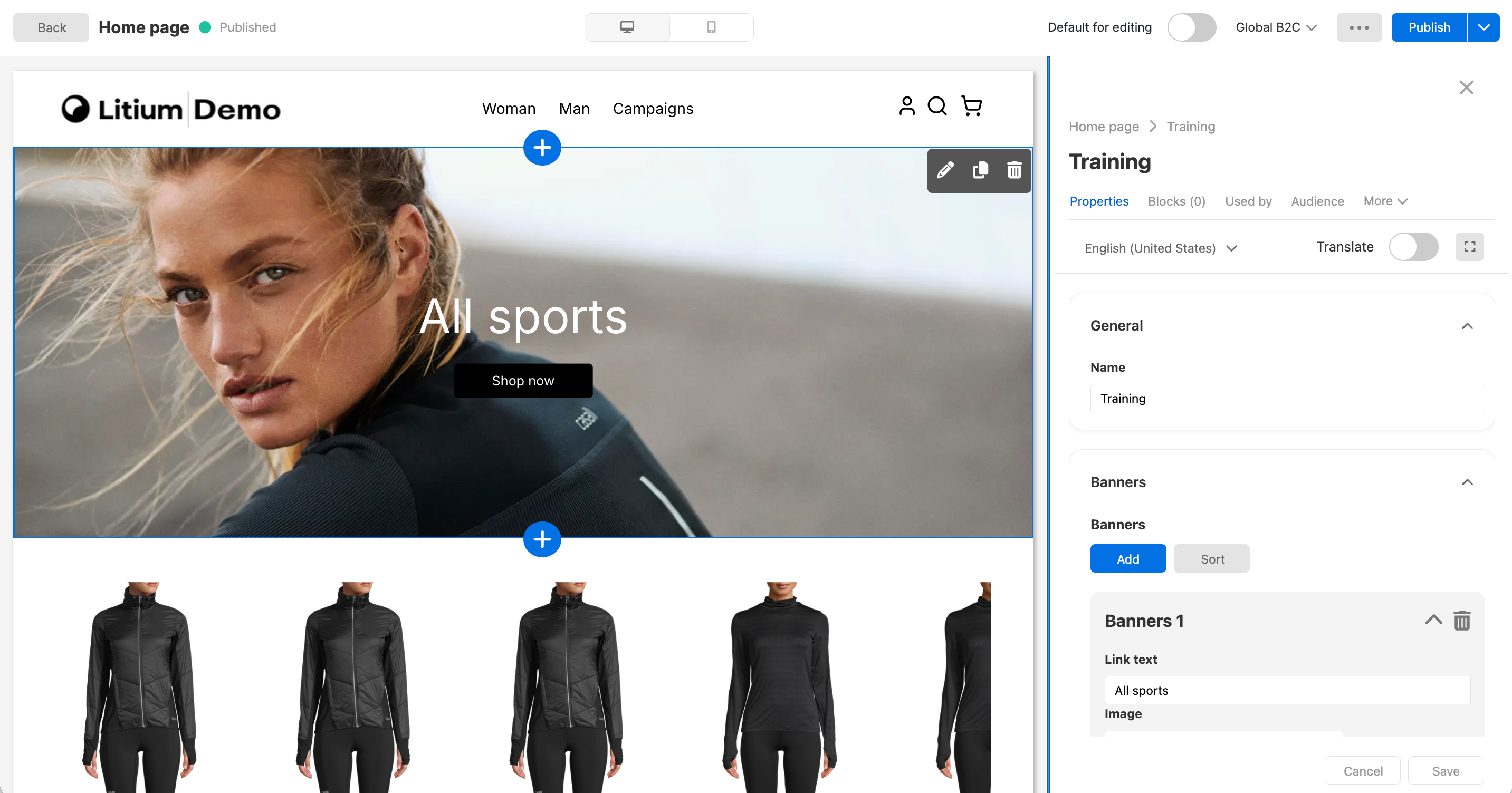
  • CMS with block management – drag-and-drop-based content building where blocks can be reused across multiple pages and adapted to visitor behaviour and previous interaction with the site.
  • B2B functionality – customer-specific price lists, own invoicing, EDI and PunchOut order management, as well as a ready-made B2B accelerator that provides a faster starting point for the project.
  • Campaign and pricing management – flexible campaign engine that makes it possible to target offers at specific audiences, markets and channels, with a unified campaign planner for overview.
  • Headless architecture via Litium Storefront API – built on React, Next.js and GraphQL for companies that want to fully decouple the frontend from the backend.
  • Litium Commerce Cloud – a cloud-based, auto-scaling hosting environment with Fastly CDN as standard and real-time statistics via Litium Insights.
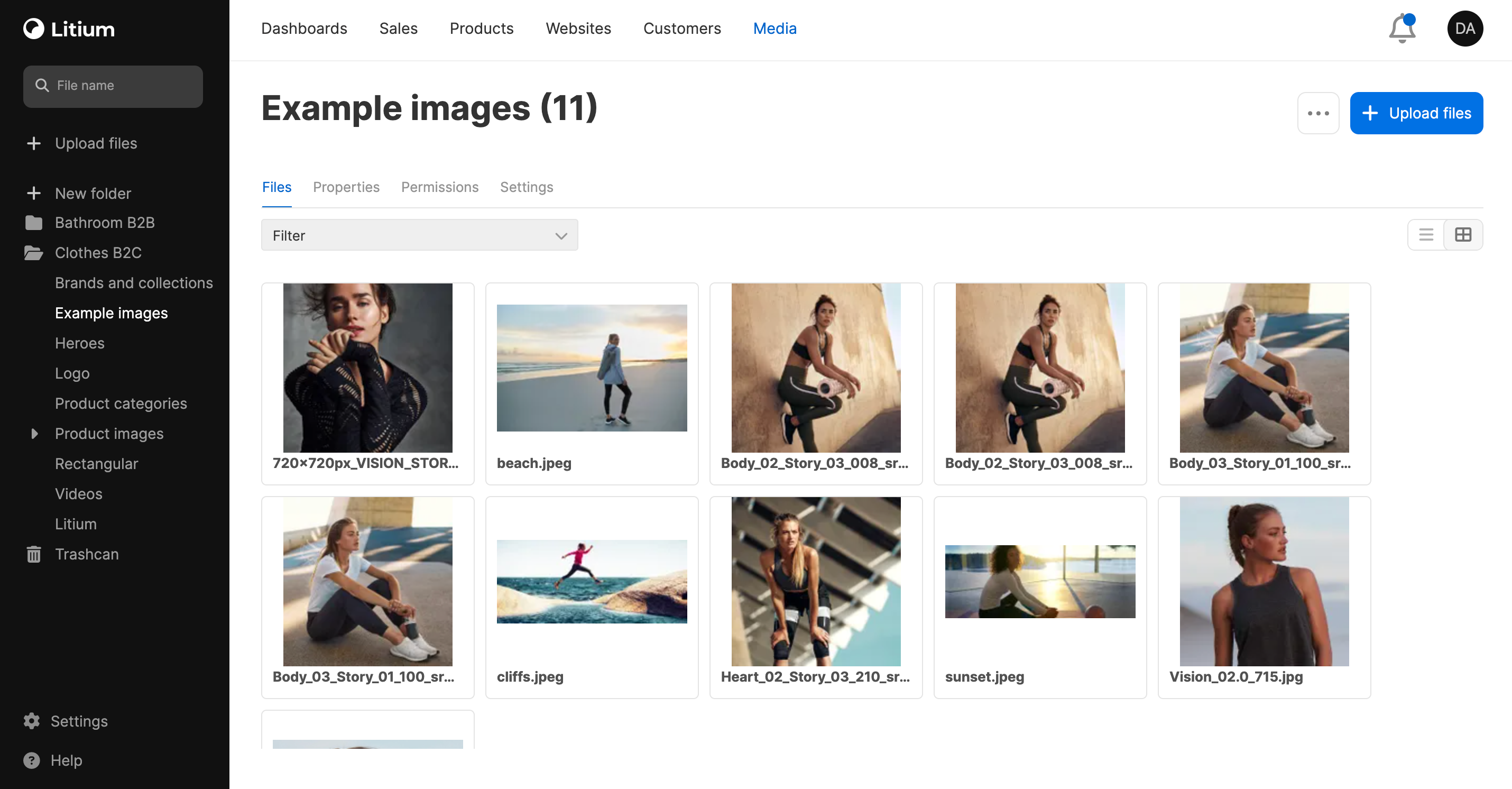
Backoffice i Litium - Mediahantering

Product company and consulting partner: a deliberate separation

Something that may surprise companies new to the Litium ecosystem is that Litium itself does not carry out implementation projects. In 2013, Litium made a strategic decision to become a pure-play product company that focuses exclusively on developing and maintaining the platform itself. Consulting, custom development and implementation are instead always handled through Litium's network of certified solution partners, who work together with the end customer to build and operate the solution.

That separation is no coincidence but a deliberate business model, and it offers several advantages for you as a customer:

  • Litium can focus one hundred percent on platform development, contributing to a high and consistent development pace with new features released continuously without the customer having to manage separate upgrade projects.
  • The partner's role is focused entirely on your business – the consulting partner spends all its time understanding your operations, your processes and your integration needs, rather than splitting focus between product development and customer delivery.
  • You can freely choose a partner based on industry experience, geographic proximity or specialist expertise, and also switch partners if the collaboration is not working, without having to switch platforms. Several Litium customers have, for example, moved to a new partner after starting with another.
  • The partner network creates competition on quality rather than on the platform's core features, which keeps delivery quality high across the entire ecosystem.

Solution partners are certified by Litium at several levels, with the most experienced partners appointed as Premium Solution Partners based on the number of certified consultants, delivered projects and customer satisfaction. As a customer, you can therefore be confident that a certified partner has both the technical competence and an established relationship with Litium as the product owner.

How do you get started with Litium?

A typical Litium project begins with a workshop together with a solution partner, where needs around products, orders, customer data, sales and logistics are mapped out to determine whether Litium is the right choice and how the solution should be configured. Litium can be integrated with virtually any business system that has an external API or file integration capability, and common integrations in the Nordic region include systems such as Microsoft Dynamics, Business Central, Jeeves, Pyramid, Visma and Fortnox.

For companies that want the fastest possible path to launch, Litium's accelerators for B2B and B2C package the functionality most e-commerce companies need as standard, reducing the amount of custom development required in an initial project.

Litium Commerce Cloud and technical architecture

Litium's latest generation of cloud service, Litium Commerce Cloud, is built to be serverless and automatically scaling, meaning that high traffic peaks – for example during campaigns or seasonal peaks – do not negatively affect performance. Fastly CDN is included as standard, contributing to faster page loads regardless of where in the world the visitor is located. Through Litium Insights, you get access to real-time data and statistics linked to your e-commerce directly in the platform, without needing to set up a separate analytics tool for basic reporting.

The new pricing model for Litium Commerce Cloud is also more favourable compared to previous versions of the platform, making it a natural step for existing Litium customers to upgrade to. The technical foundation is built on modern, well-established technologies such as React, Next.js and GraphQL for those who choose to go headless via the Storefront API, making it easier to recruit developers and find competence on the market compared to more niche technical stacks.

Blockhantering i Litiums backoffice

Litium’s partner network in practice

Litium's partner network consists of several levels of certified solution partners, from basic certification to the status of Premium Solution Partner – a level currently held by only a handful of agencies in the country. To reach the highest level, a large number of certified consultants, a strong delivery track record of high-quality Litium projects, and a proactive collaboration with Litium as the product owner are required.

For you as a customer, this means you can choose a partner based on actual delivery quality and industry experience rather than being locked into a single supplier's route into the platform. It is also not uncommon for companies to switch solution partner mid-way through their Litium journey if the collaboration is not working as expected, without it meaning a platform change – a reassurance that many other platform models, where the product owner and implementation partner are the same company, do not offer in the same way.

How does Litium differ from other e-commerce platforms?

In the Swedish and Nordic market, Litium competes primarily with other established platforms such as Norce, but also with international alternatives such as Shopify Plus and Adobe Commerce. The clearest difference compared to more pure-play headless engines like Norce is that Litium offers a ready-made presentation layer and CMS included in the base package, meaning more companies can get started without needing to build an entirely custom frontend from the outset. Against international SaaS alternatives such as Shopify Plus, Litium's advantage is often the depth of B2B functionality and the fact that the platform, its partner network and support are well adapted to Nordic business conditions, currencies and integration standards.

At the same time, Litium's partner-driven model means that the quality of an individual project is largely determined by which solution partner you choose, rather than solely by the platform's technical capability. This makes the choice of partner an equally important part of the decision as the choice of platform – something that differs from platforms where the product owner themselves delivers the implementation.

Examples of companies using Litium

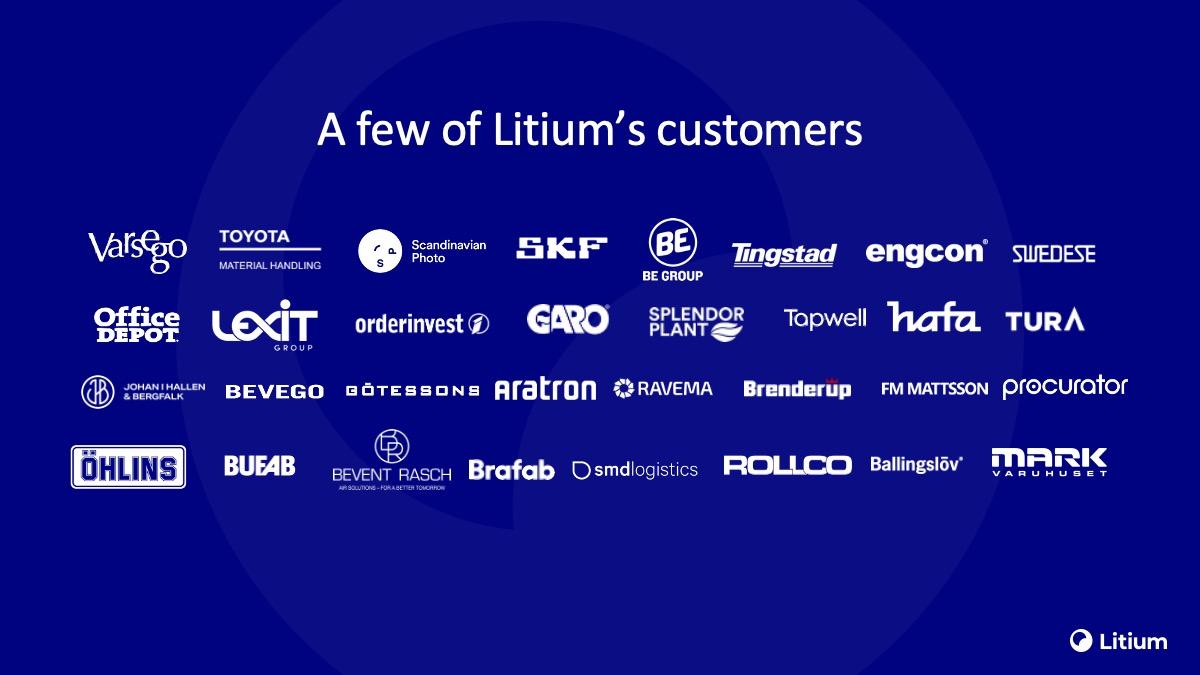
At Motillo, we have for several years built and further developed Litium solutions for a range of Nordic companies, illustrating the platform's flexibility in practice. Tapethandeln and Färgvaruhuset, which are part of the Ahlsell group, are one example where two stores are run on the same Litium installation with separate assortments and customer journeys for each brand. SMD Logistics is another example, where several billion in sales pass through the solution every year. Among other customers are Kellfri, which sells agricultural products, Cyberphoto, which was one of Sweden's very first e-commerce retailers, and shock absorber specialist Öhlins Racing, which manages product information and online sales across multiple markets around the world.

What these examples have in common is that they all combine a need for scalability with requirements for deep B2B or B2C functionality, large product assortments, or multiple brands in the same solution – exactly the combination that Litium's platform and partner model is built to handle well.

Litium customers

Summary

Litium is a mature, Swedish e-commerce platform with a clear focus on mid-sized to large B2B and B2C companies that want to combine content, product data and sales in a cohesive solution. The model where Litium acts as a pure-play product company and all implementation is carried out through certified solution partners delivers a combination of rapid platform development and deep, customer-close consulting expertise – a separation that in the long run benefits both quality and flexibility for you as a customer.

Frequently asked questions about Litium

  • Yes, Litium can be integrated with ERP systems in several ways — either API-based through Litium's own APIs, file-based, or through a fully custom integration.

  • A Litium project that includes all components — design, platform implementation, configuration, PIM modelling, ERP integration, testing and project management — typically costs somewhere between SEK 750,000 and SEK 1.5 million. The difference depends on the amount of custom development, integrations and the level of ambition in the design work. Of course, there are examples of solutions built at both lower and higher costs than this.

    In addition to the project cost, there is an ongoing licence fee for the platform itself, which is governed by the volume of sales generated through the solution.

    Contact us for a current price estimate for your specific business.

  • No, Litium projects are implemented by a certified Solution Partner, who is also responsible for support and ongoing maintenance of the solution.

  • Yes, the platform supports pure B2C commerce, pure B2B commerce, and the combination B2B2C on the same instance, with separate logic and rules per customer type.

  • Litium can be used both in an integrated mode — with the platform's own CMS and presentation layer — and fully headless via the Litium Storefront API for companies that want to build their own frontend.

  • Litium supports multisite operation, meaning that multiple stores or brands can run on the same platform instance with shared product data but separate customer experiences, pricing and domains. This is a common setup for companies running both B2B and B2C, or for groups with multiple brands.

  • The B2B accelerator is a ready-made starting point for B2B projects on Litium that packages the functionality most B2B merchants need: account management with organisational hierarchies, customer-specific price lists, quote flows, quick order and basic checkout logic for business customers. This reduces the amount of custom development in an initial project and shortens time-to-market.

  • Litium's built-in PIM system is designed to handle large assortments with complex variants, bundles and product relationships. Product data can be enriched centrally and then distributed to multiple stores, markets and channels from a single data source, reducing the risk of inconsistency between channels.

Is Litium the right choice for you?

Motillo is a Premium Solution Partner to Litium and helps Nordic B2B and B2C companies get started with, or further develop, their Litium solution. We are happy to help you evaluate whether Litium is the right platform for you.

Is Litium the right choice for you?

Your digital growth partner

We make sure strategy becomes reality, combining technology with marketing so that you grow faster.

Got any questions?

Get in touch and we'll talk about your growth journey

Simon Andersson

Simon Andersson

Försäljning & rådgivning