Skip to content
Motillo

How much does Shopify cost compared to open-source Medusa in 2026?

Jakob Twedmark

Jakob Twedmark

VD & Rådgivare

How much does Shopify cost compared to open-source Medusa in 2026?

When evaluating e-commerce platforms, many people look at the monthly cost at current sales volumes. But that number says little about what the platform will cost in three years, when sales have grown and the business has evolved. Many platforms charge in proportion to your revenue, through license fees, transaction fees or fees for third-party payments. Others, like the open-source platform Medusa, have no license fee at all. There, a larger share of the cost lies in development and operations instead.

In this article, we walk through what an e-commerce platform actually costs, which costs are easy to miss and how the total cost changes as you grow. We take a deep dive into the costs of the popular Shopify and compare them with the open-source challenger Medusa.

What does an e-commerce platform cost?

The short answer: what does an e-commerce platform cost?

  • SaaS platforms for smaller stores (e.g. Shopify Basic–Advanced): from around €25 to €350 per month, plus transaction and app fees.
  • SaaS for larger merchants (e.g. Shopify Plus): from around USD 2,300–2,500 per month depending on contract length. Above a certain revenue level, the fixed amount is replaced by a variable fee of around 0.35–0.40% of sales.
  • License-free open source (e.g. Medusa): €0 in license fees and 0% in transaction fees. You pay for implementation, hosting and ongoing development.

So the right answer depends less on the monthly price and more on how the cost develops as your sales grow.

Two people playing table tennis

The five costs of an e-commerce platform

  1. Fixed costs
    The fixed price for using the platform. With SaaS, hosting, security and updates are included.
  2. Variable costs
    This part is usually harder to find information about. One can only speculate why, but it can clearly become substantial for merchants whose revenue has grown. Most platforms have a revenue cap on their fixed fee, and a revenue-based fee kicks in once that cap is passed. Shopify also charges an extra fee if you don't use Shopify Payments as your primary payment solution.
  3. Apps and add-ons
    Features such as reviews, B2B price lists, search, loyalty and translation are often built with apps that have their own monthly fees. Ten apps at €30–90 per month each is not unusual.
  4. Implementation and integrations
    Design, development and integrations with ERP systems (e.g. Pyramid, Business Central or Jeeves), payments, shipping and email marketing. It is a one-off cost, but it varies greatly with complexity.
  5. Operations and ongoing development
    Hosting, monitoring, updates and new functionality over time. With SaaS, some of this is included in the subscription. With open source, you or your partner are responsible for it.
Shopify

How much does Shopify cost?

For many, Shopify is the natural first choice: quick to get started with and a low fixed price. Here is what pricing looks like in October 2026 (USD per month with annual / monthly billing):

  • Basic: USD 29–39 per month. 2% extra fee for payment methods other than Shopify Payments.
  • Grow: USD 79–105 per month. 1% extra fee for payment methods other than Shopify Payments.
  • Advanced: USD 299–399 per month. 0.6% extra fee for payment methods other than Shopify Payments.
  • Plus: from around USD 2,500 per month on a one-year contract. Variable costs are added when sales exceed certain thresholds (see below). 0.2% extra fee for payment methods other than Shopify Payments.

Variable license costs for Shopify Plus are added as sales grow

Shopify does not publish an official price list for the variable part of Plus. According to Shopify partners, the fixed subscription is replaced by a variable platform fee once sales are large enough: around 0.40% of revenue on a one-year contract and 0.35% on a three-year contract (for B2C sales). You pay whichever is higher of the subscription and the variable fee. According to most sources, the switch happens at roughly USD 625,000–800,000 in monthly sales, equivalent to around €6.5–8.5M per year. The fee is reported to be capped at around USD 40,000 per month and can be negotiated, so read your contract carefully.

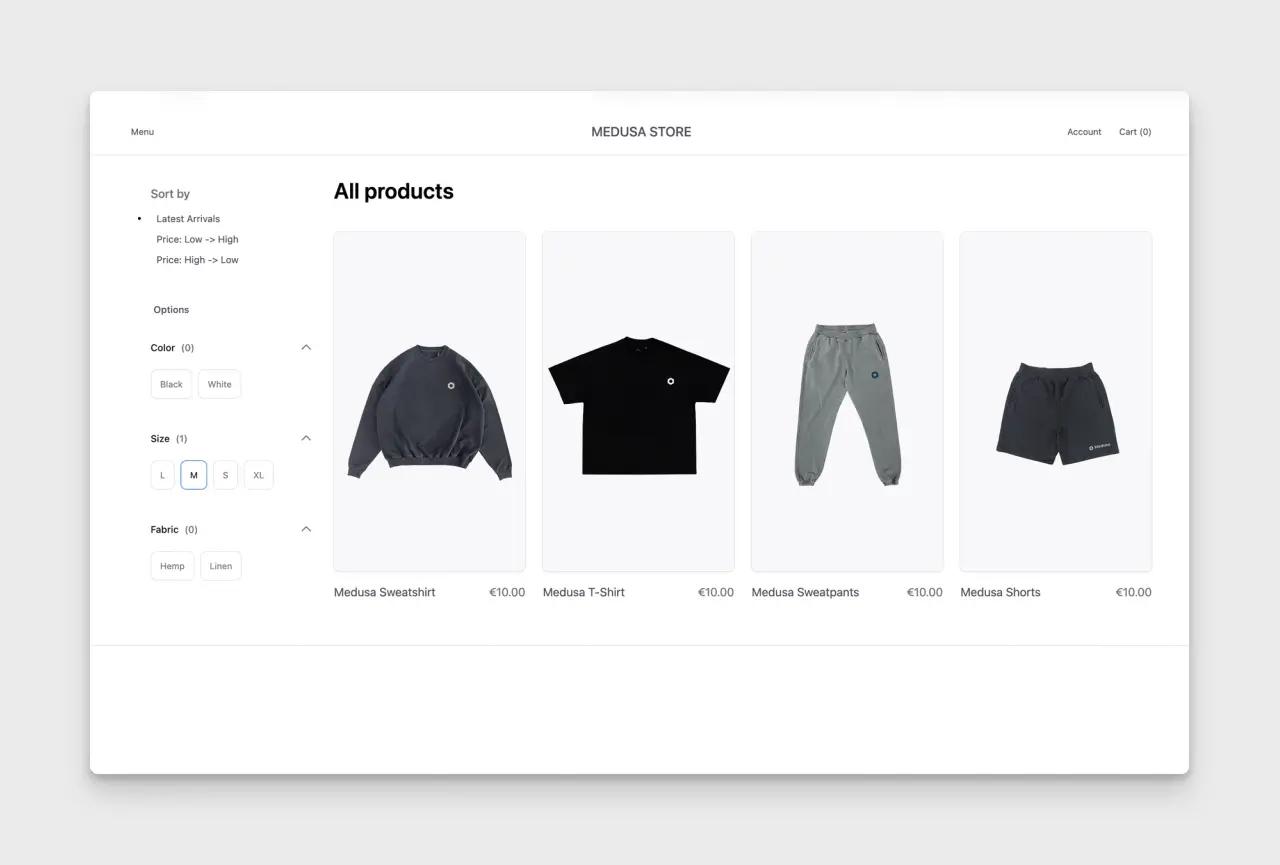
Example image from Shopify
Medusa

How much does Medusa cost?

Medusa is an open-source platform under the MIT license. This means:

  • License: €0.
  • Transaction fee: 0%. You only pay your payment provider's own fees.
  • Hosting: your own cloud environment or Medusa Cloud, from around USD 29/month for development and USD 99–299/month for production environments. Medusa Cloud charges no fee on revenue, but bills for usage: compute, data transfer, storage and additional user seats. In the customer examples Medusa has published, mid-sized merchants with a few thousand orders per month or very large product catalogs end up at around USD 360–600/month. That corresponds to roughly €310–520/month. Larger merchants often end up on the Enterprise tier, which is priced on request.
  • Implementation: the largest cost. You build a store tailored to your business, instead of adapting your business to a platform.
  • Ongoing development: needed, but you own the code and can switch partners without switching platforms. You can also handle development in-house.

In short: Medusa shifts the cost from an ongoing, revenue-based license to an investment in your own platform.

How much does Medusa cost?
Worked example

How costs change as you grow

The example shows costs both with and without Shopify Payments. If you use another payment solution as your main checkout, such as Kustom, Qliro, Stripe or Adyen (common in the Nordics), Shopify charges a third-party fee on every order: 0.6% on Advanced and 0.2% on Plus. If you use Shopify Payments, you avoid that fee but pay Shopify's own card fees instead. The payment fees themselves are not included in any of the figures, since they apply regardless of which payment solution you choose. The difference lies in the terms you can get, which we come back to below.

The example is simplified and only covers the platform's fixed and variable fees, not the payment provider's own fees, implementation or apps. Exchange rate approx. €0.87/USD. The Shopify Plus figures are based on industry data on the variable platform fee, since Shopify does not publish it officially. The Medusa figures are an average based on Medusa Cloud's price list and the customer examples Medusa has published. The actual cost may be higher or lower, since it follows load and catalog size rather than revenue, but we have assumed that it increases as the business grows. At €50M, the figure is an estimate, since merchants of that size normally get custom pricing on the Enterprise tier.

The monthly platform cost is calculated as follows:

  • Shopify Advanced: approx. €260/month in subscription + 0.6% of revenue if you don't use Shopify Payments
  • Shopify Plus: approx. €2,180/month in subscription + 0.2% of revenue if you don't use Shopify Payments. When 0.40% of revenue exceeds the subscription, from around €6.5M in annual revenue, the subscription is replaced by the variable platform fee (one-year contract, B2C). The variable platform fee also applies with Shopify Payments.
  • Medusa: 0% of revenue + hosting on Medusa Cloud, on average from approx. €230/month for a smaller store to approx. €920/month for a large merchant. The cost is driven by load, number of products and integrations, not by revenue.

Monthly platform cost with and without Shopify Payments (fixed and variable platform fees, excluding payment fees, EUR/month)

Annual revenueShopify Advanced with Shopify PaymentsShopify Advanced with another payment solutionShopify Plus with Shopify PaymentsShopify Plus with another payment solutionMedusa with any payment solution
€1Mapprox. €260approx. €760approx. €2,180approx. €2,350approx. €230
€5Mapprox. €260approx. €2,760approx. €2,180approx. €3,010approx. €460
€10MNot applicableNot applicableapprox. €3,330approx. €5,000approx. €690
€50MNot applicableNot applicableapprox. €16,670approx. €25,000approx. €920

It is worth keeping in mind that Medusa is a more technical platform than Shopify, and may require a larger initial investment and ongoing work to maintain the platform. The curves, however, are clear: with SaaS and licenses, the platform cost grows with your sales; with open source, it doesn't. The larger you grow, the faster you recoup the implementation cost.

Why the freedom to choose your payment solution matters

Payments are often one of the larger ongoing costs in e-commerce. The fees are charged as a percentage of every order, so even a few tenths of a percentage point add up to large amounts as revenue grows.

Shopify's third-party fee makes it more expensive in practice to choose anything other than Shopify Payments, since it is added on top of the payment provider's own fee. Klarna, Adyen or Qliro therefore can't compete with Shopify Payments on equal terms: they must be cheaper by the full third-party fee for a switch to pay off. This shields Shopify's own payment service from real competition and weakens your negotiating position.

With a platform like Medusa, there is no such fee. You can procure a payment solution when it suits you, negotiate the terms, switch providers or combine several, without the platform charging you for that choice. It is competition between payment providers that drives prices down, and it only works if you are free to switch.

TCO over 3 to 5 years

How to calculate total cost of ownership (TCO) over three to five years

  1. Forecast revenue for years 1, 3 and 5, per market and channel (B2C, B2B, marketplaces).
  2. Calculate all variable fees at each level: license, transaction fees, third-party fees, apps.
  3. Add implementation and integrations with ERP, payments and shipping.
  4. Add operations and ongoing development per year.
  5. Assess lock-in. What will it cost to switch platforms again in five years? With open source, you own the code. With SaaS, you have to rebuild.

Want help with the calculation? That is exactly what we do in a technical discovery.

How to calculate total cost of ownership (TCO) over three to five years
Which platform

Which e-commerce platform is best for you?

  • Shopify suits D2C brands that want to launch quickly, have a simple product structure, don't want to focus on technology and have limited requirements for integrations and customizations.
  • Medusa suits growing B2C and B2B companies that want to build unique functionality, have some interest in technology and want to grow without the platform's pricing model driving up the total cost.

For a more detailed comparison, see Medusa vs Shopify.

Which e-commerce platform is best for you?
Motillo Pegasus

License-free e-commerce with Motillo Pegasus

Motillo Pegasus is our AI-first, license-free e-commerce platform built on Medusa. You get:

  • €0 in license fees and no transaction fees. Your sales grow, your license cost stays put.
  • Fixed-price migration in 6–12 weeks, from kickoff to launch.
  • Motillo AI for product copy, translations and SEO/GEO analysis, with drafts reviewed by your editor.
  • Ready-made integrations with Pyramid, Business Central, Jeeves and Monitor, Klarna/Kustom, Qliro, Adyen and Stripe, as well as Klaviyo and Rule, among others.

Book a demo of Pegasus →

Frequently asked questions about e-commerce platform costs

  • Often at first. As revenue grows, transaction, app and platform fees increase, especially if you use a payment solution other than Shopify Payments.

  • The platform itself is free and open source under the MIT license. You pay for hosting, development and maintenance, but never a license fee or a percentage of your sales.

  • A percentage fee the platform charges per order, on top of the payment provider's fee. It makes the platform cost rise in step with your sales.

  • When fees clearly start tracking your revenue, when apps and customizations become hard to maintain, or when the platform holds back new business models such as B2B or new markets. Calculate TCO over three to five years before you decide.

  • With Motillo Pegasus, the migration is carried out at a fixed price in 6–12 weeks, depending on scope and integrations.

More articles

Got any questions?

Get in touch and we'll talk about your growth journey